Click!

Showing posts with label Superman. Show all posts

Friday, November 23, 2012

Comic Book Reviews for Recent DC Releases


"Yeah, can we just try to drive home the point that Aquaman's a total bad-ass every chance we can? Great. Thanks."


JUSTICE LEAGUE #14

Written by: 
Geoff Johns
Art by: 
Tony S. Daniel
Richard Friend
Backup Art by: 
Gary Frank
Cover by: 
Tony S. Daniel
Richard Friend

Have fans had enough shenanigans to last a lifetime with this hacked-together driftwood that DC is producing with recent issues of Justice League? You know you're in trouble when your main event story arc is so waif-like it feels like it's being bullied by the backup story with Shazam! (which for some reason makes one think there are sick times in store for the beleaguered Billy Batson). The art, as ever, is pretty in a refined sugar kind of way.

Honestly, there isn't much to say for the story of the Justice League up to this point. Stuff is happening, sure, but there's rarely any extension of tension in the content.  The whole thing feels forced like absolutely nothing else Geoff Johns has ever written, and much like the Star Wars prequels, these issues cannot be undone.  They're canon now, we can only move on.  It feels like Johns is removed even further from his comfort zone with the (temporary) removal of Hal Jordan from the team, and the focus on a (forced forced forced forced) relationship between Wonder Woman and Superman felt like it lacked the passion it might have had with, say, years of actual build-up, as it has been rumbling in the background of the main arc for a minute now.  But the final page/panel of this issue is the greatest and most frustrating tease of all, as it seems to imply that something has been going on under the surface of these hollow automaton pose-a-thon caricatures the entire time. 

But that's just a tease, maybe. Nothing to see here yet, kids, move along.


6.5/10


What is this goofy mess? Superman looks, like, twelve years old. Heck, Jason Todd has more crow's feet than him.


RED HOOD AND THE OUTLAWS #14

Written by: 
Scott Lobdell
Art by: 
Pascal Alixe
Cover by: 
Kenneth Rocafort 

A genuinely guilty pleasure of this reviewer is the smart and slick surprise sleeper, Red Hood and the Outlaws.  Whether taking on Obese Asian Mob Mistresses, fighting smoke ninjas, or taking on alien menaces, the jumping bean of the major arcs in this series seems to lead us into a nostalgic singalong.  With Starfire (amnesiac nymphomaniac alien princess) and Arsenal (that, um, goofy bro with the trick arrows and a big mouth) backing up Jason Todd (Robin II, aka Red Hood, aka dead man walking) in his misadventures, there's no way to successfully summarize the main thrust or moral to this comic book. And it wouldn't work any other way.  That... and Pascal Alixe's art could make anything look cool.

Red Hood and the Outlaws succeeds where many other titles along the same vein or corner of the DC New 52 essentially fail.  The failure of Teen Titans, or The Ravagers, or whatever other mess being spawned by Image-hacks of Christmas Past, is that the overarching plot crushes any real chance at characterization, which in turn kills investment in the overarching plot.  Instead of fleshed-out dialogue and events, flattened stick-puppets in flashy costumes react verbosely again and again to some (likely misunderstood) villain with nigh-infinite powers and an endless array of schemes within plots within schemes, amounting to bupkiss, since nobody involved is easy to access or relate to.  

In Red Hood and the Outlaws, we're put in third person limited omniscient perspective with essentially a cast of three characters, and each character's motivations are explored alongside the demons and angels of their personal backstories that inevitably pop up.

With this issue, Superman shows up and the standard superhero slugfest ensues. Except it doesn't feel forced or stupid. Scott Lobdell has grown increasingly comfortable with this comic, as evidenced by the spunky manner in which he chooses to approach it. It's not stale, it's not automatically painful, and where it lags, Pascal's art kicks in and distracts. Well played, overall, and consistent with what it promises.


8/10

You know you're in trouble when the slobbering alien starts firing yellow dwarfs at you.


GREEN LANTERN NEW GUARDIANS #14
Written by: 
Tony Bedard
Art by: 
Aaron Kuder
Cover by: 
Aaron Kuder
Variant Cover by: 
Aaron Kuder

Good old Kyle Rayner. More approachable than any other Green Lantern in the sector, and possibly the savior of the entire universe, soon enough. For some reason I have a soft spot for Green Lantern: New Guardians. It's quirky and moves at a brisk pace, exploring the potential for cosmic DCU done right. The art is consistent and quiet at times, then dazzles with the technological wonders of computer content playing with the chromatic content generated in the Green Lantern sector of the DCU New 52. It feels less forced than some titles and characters, you aren't forced to jettison decades of hard-won memories in the nostalgia fields just to enjoy the actions taking place. Characters are explored, up-sized, fleshed-out, and turned around each issue, and the cast of characters is such that the protagonist of any story might be explored tangentially to the overarching plot, namely the Guardians of the Universe are evil as hell and have raised a Third Army, rendered Hal Jordan and Sinestro moot, and are even now finding new ways to make readers hate them every issue. It's all building up to something big, and the spine of that mega-event is New Guardians. Expect its spotlight to brighten soon.


8.5/10


The classic "Fat Mobster type strikes a deal with a Demon", you know, the usual. No bigs.


DC COMICS PRESENTS #14: Blue Devil & Black Lightning 

Written by: 
Marc Andreyko
Art by: 
Robson Rocha
Cover by: 
Ryan Sook

It's nice that DC has seen fit to use DC Comics Presents as a testing ground for all the characters that don't get their own continuous series.  Black Lightning had an interesting investment in the Final Crisis storyline of universes gone past, and Blue Devil found himself in the breakroom of the Justice League Headquarters not a few times over the years.  Now the two of them team up to stop a demon and his soul-trafficking mobster with a skin condition and a glandular problem. Overall the art gets kitschy when everything slows down, but in certain pages the kinetics of it give the action an enhancement. Not a bad story, but by the numbers with just enough developments to keep a reader reading. Maybe.

7.5/10
Joker's back. And he's playing mind games with Catwoman to an absolutely ridiculous extent.


CATWOMAN #14
Written by:
Ann Nocenti
Art by:
Rafael Sandoval
Jordi Tarrogona
Cover by:
Trevor McCarthy

This issue of Catwoman is aggravating, due to its ties to the current crossover in Bat-titles "Death in the Family"... yet compelling in its own right. This particular issue goes with the new format of all Batman related titles, namely "Let's all have a heart-to-heart with the Joker", better known as "Death of the Family", wherein the Joker, having had his face surgically removed off-camera, somehow develops superhuman-like powers, not unlike Wolverine, where he can simultaneously be everywhere at once and at the same time develop elaborate death traps, break the neck of every policeman in a station save one, kidnap Alfred, recreate every single action he'd ever made up until this time and monologue until you want to claw his face back off. Here he continues with his amazing new Joker powers by conning Catwoman into paralyzing herself and get a bunch of bat-symbols all over her.  Nothing really feels like it's heading anywhere, and by the time we get to our stop on this ride, we may have already fallen asleep. Catwoman started fresh and still has a bit of that in it, but not for quirky cross-overs that feel like "talkies".


7/10


All the overlapping conversations of 100 Bullets are finally revealed in Wonder Woman, for some reason.


WONDER WOMAN #14

Written by:
Brian Azzarello
Art by:
Tony Akins
Dan Green
Cover by:
Cliff Chiang
Variant Cover by:
Cliff Chiang

Brian Azzarello is doing a good job with Wonder Woman and retooling the mythology of her new place in the DC Universe. The overall reverence for the gods and goddesses, fitting, one would suppose, is the circulatory system that makes this book function. Gone are all the mismatched peculiarities and baggage of the previous volumes, now at least her motives are clear and present. The interactions with all the offshoots of deity and godlings and established scions has been ongoing since this series began, and it seems to sit in its own remote location in the DCU New 52, far away from continuities that would muss it up. This is positive, for the time being, allowing Azzarello to enrich Diana in the manner in which she deserves. Where the Justice League's Wonder Woman feels more teeth-gritting and over-archetyped, the Wonder Woman in her own title is more regal in her bearing, fearless but not beligerrant, and overall inhabiting both her godly namesake and another thing entirely, a far cry from when she was a gimmicky drama queen or a murderous misandrist.


9/10

Friday, September 28, 2012

Reviews for Recent Comic Book Publications


Mainstream comic books in their present condition are such that the amount of capital invested to seed the future cineplex blockbusters is reflected through examples of the medium's true potential, as expressed in successes and even in the failures of its most dismal dregs.  As well adjusted members of American society slough off the birthing cowl of high school, so too must comic books deal with their history as a medium geared and stunted for decades towards children and grown-up children.  Superheroes are as integral to comic books as a medium as the journey of the hero is integral to most ancient and modern mythologies.  How well they are dealt with matters a great deal to the industry. 

It is the intent here to draw from the entrenched dichotomy of the supposed mainstream, the "House DC" and the "House Marvel" if you will, and analyze the weight and worth of their good and bad and meh recent releases, individually or in the context of story.  In fact, scores for each issue are weighted towards story, with exceptional art tipping the scales towards bonus points unless dreadful. Assessments draw from the history of the standard for each title, within and without the medium's standardized history.  Attributions for each review are added on a title by title basis.  


I, VAMPIRE #0
Written by: 
Joshua Hale Fialkov
Art by: 
Andrea Sorrentino
Cover by: 
Clayton Crain


We all know that a "DC Vampire" book to fill in the gaps near where a proper Vertigo title (American Vampire) germinates was somewhat inevitable, given the nature of the social biosphere that lets pap like Twilight create a buzz among young fools.  I, Vampire emerged in the post-Flashpoint foam of the New 52 as a stand-alone anomaly, meeting at odd angles with Justice League Dark in the "fantastic and magic" corner of the DC Comics New 52 color-wheel.  It's done a serviceable job to its readers and seems to take the popular Faustian trope for its main character, Andrew Bennett.     

The art for this particular issue sells the story in panels seething modernist influences of the medium and accenting them with a tinge, a pinch, a mere touch of Gothic sensibilities.  We get the origin story for Bennet, his connection and encounter with Cain, the first vampire.  The pacing is spectacular, the multi-page unfoldings by Andrea Sorrentino worth careful examination and appreciation.  In the dustbins of comic books, this title shines like a blood-red diamond. A fabulous combination of elements and delivers what it promises, specifically vampires, in a fresh, slick, well-executed package.

9/10


THE AMAZING SPIDER-MAN #694
Writer: 
Dan Slott
Penciller: 
Humberto Ramos


Throughout Spidey's career, he has been crushed under tremendous weights multiple times, both literal and situation-based.  I can recall the hologram foil issue of Amazing Spider-Man #365 where Spider-Man fought the Lizard in one of their many sewer-based conflicts, brick-debris and a train from Penn Station nearly crushed him. In true-to-character fashion, he thinks of all those relying on him, and finds the strength to Hulk out in his own fashion and free himself. 329 issues and several crushings later, he does something he's never done before. He acts as landing gear for a plane with Aunt May and Aunt May's pilot boyfriend on it, as well as many other civilians, J. Jonah Jameson's family members, and a cute puppy in the cargo hold.

Why?  Well, a few issues back with his gig at Horizon Labs, Peter Parker accidentally gave an irresponsible iPhone twittering jackass punk kid superpowers. The kid named himself Alpha and, in this issue, smacks around a near-cosmic villain like a tiger pwning a puppy.  In the process, though, he nearly kills a goodly sum of civilians, hence the Spider-landing-gear.  With each issue since the Spider Island scenario, Amazing Spider-Man has proven that it can pack in fresher scenarios of interest into what should be a rather tired enterprise of recycled plot.  There are still surprises and a marked gradation of potential for Spidey and Parker now, less restricted by the limitations of his origins. As super-genius and masked vigilante carrying cards to both the Avengers and the Future Foundation, Spider-Man has settled into "middle age" rather comfortably. The art and writing hit where they fit, and this issue is a relevant example of that.    

9/10


BATMAN INCORPORATED #0
Written by: 
Grant Morrison
Chris Burnham
Art by: 
Chris Burnham
Cover by: 
Chris Burnham
Variant Cover by: 
Aaron Kuder
Chris Burnham


It has not happened yet, but it will someday. A character is designed for a comic book that will be the synthesis of Batman without the bat, that takes a stance towards corporate accountability in a fashion where the scum of a certain 1% are taken to task for their malevolence.  Until then, we have Batman Incorporated.  Grant Morrison extends into his personal mythos of the balance between Bruce Wayne's money and Batman's dogged determination.  Batman as a global icon to be established with certain individuals throughout the globe is part of the nostalgia that is built into Grant Morrison's style and approach with DC Universe characters.  Behind all the merely clever bits he hearkens to the same thing all successful comic book writers do: he finds where he fell in love with comics and writes that. 

 The age of Morrison when he first touched a comic book was an era where a league of Batman-inspired international heroes came together to fight the injustices close and far from home.  It was a time of goody LSD-exploded rainbow Batmen and artificially sweetened boy wonders.  An extension of his well-done Black Glove storyline, Morrison's Batman Inc. #0 is a backstory for all the heroes of Africa, Russia, Japan, England, and Australia, but if this were to extend further could we find one in India, or for that matter Pakistan?  There is the promise of riches to come for DC if they continue to allow Morrison reign over their dreamscape archetypes, with the art possessing a dynamic shift from still to kinetic with every page, fitting every scene.   

9/10


FF #22
Writer: 
Jonathan Hickman
Penciller (cover): 
Ryan Stegman
Artist: 
Nick Dragotta


We have already established that Jonathan Hickman is a Comic Book God by some rights, and his ability to make a second ongoing title for the Fantastic Four, a long-troublesome and sometimes near-dead enterprise, is testament to his strengths.  His weaknesses come about in the noticeable contrivance of "wrapping up dangling plot-threads".  At times entire issues simply lack the weight of driving action required for the comic book medium, but they serve a sound architecture of plot overall, and at his worst Hickman's dialogue is too choppy or verbose, but it never seems hackneyed or dumb.  With FF #22, in the fallout of major cosmic storylines preceding it, the Fantastic Four (with Spidey! Five! Fantastic Five!) confront the self-styled science messiah The Wizard on an AIM island compound.  Bentley, a clone of The Wizard, has been raised in the FF family for some time now, the "inherently evil" wise-cracker kid akin to DC's Damian Wayne without ninja assassin training.  As always, Hickman delivers and the art is crisp perfect flow.  With Hickman's recently announced departure from Fantastic Four, it'll be interesting to see what direction FF, very much his brain-child, will head. Nick Dragotta's artwork is a perfect compliment to this series, with comfortably sparse scenery setting apt tones and characters possessing solid emotion to their expressions.

9/10


THE FURY OF FIRESTORM: THE NUCLEAR MEN #0
Written by: 
Joe Harris
Art by: 
Yildiray Cinar
Marlo Alquiza
Cover by: 
Yildiray Cinar
Marlo Alquiza


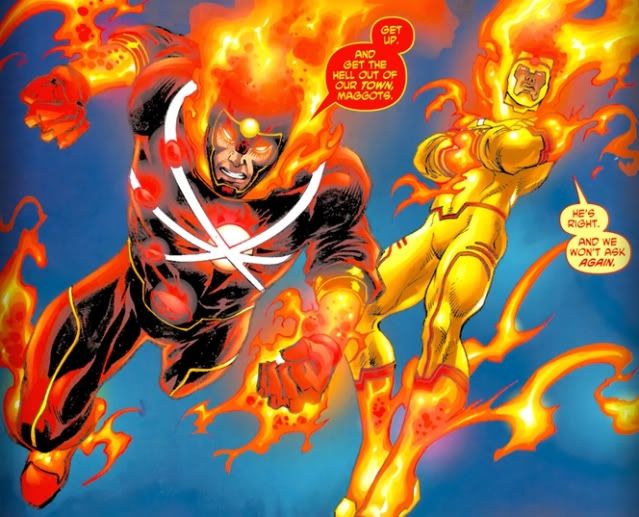
Perhaps someday Firestorm will be more than a simple superhero slugfest book.  Mind you, that was the limitation imposed on it by virtue of the New 52, where Blackest Night seemingly never happened, nor did Firestorm's entire history. The Fury of Firestorm series has read up to this issue #0 as "the superhuman weapon" motif gone weird, the Firestorm Protocols.  Captain Atom deals with the themes of the scope of his matter-manipulation powers, whereas Firestorm just apparently blows stuff up.  Firestorms, plural. Sorry.  

Major problems for this series include but are not limited to the flat characters, the seemingly pointless story arcs interrupted by seemingly pointless shock value explosions, often set at public landmarks and/or sporting events.  It may be that the series is geared towards action junkies that aren't looking for finesse or plot, but rudimentary structures set to give the flat randomly-motivated characters room to explain the things they're seeing as said things are seen, or spout cliche threats against people dressed just like them. The Fury of Firestorm: The Nuclear Man is garbled nonsense at its worst moments and regurgitated fight scenes at its best. The profundities and potential of the characters understanding their powers or having something more to them than simple reaction scenarios is never really explored for more than a moment. If the series is to survive, it needs to carry more emotional weight, or at least pretend it can. 

5/10


SPACE PUNISHER #3
Writer: 
Frank Tieri
Penciller: 
Mark Texeira


There's silly and then there's silly that knows how silly it is. On the heels of Deadpool Kills the Marvel Universe limited series comes a type akin in its major meta-style kookiness. Space Punisher, which is exactly what it sounds like. It's the Punisher. In space. This is that bit every Marvel fan speculated on at least once, where Frank Castle, armed with only a robot and space age weaponry, goes cosmic kill-ride with a list of most of the cosmic names of the Marvel Universe, along with variations of villains to murder memorably as he goes.  If you like over-the-top action thrill rides, senseless violence, and tentacle clone armies of Hitlers, heroes and characters warped between humor of Lobo and the no-nonsense ultraviolence of Judge Dredd, this piece of Marvel weird come to life lies somewhere in between.  In this almost-hilarious enterprise of an issue, Frank Castle gets closer and closer to his answers, and the Watchers that killed his family are in his sights. There's no need to think too hard about this one. It's a limited series, and it's fully aware of itself. The art is at times too spare, but overall it's a piece that can be spotted for what it is. Fun and action.

7.5/10


SUPERMAN #0
Written by: 
Scott Lobdell
Art by: 
Kenneth Rocafort
Cover by: 
Kenneth Rocafort
Variant Cover by: 
Kenneth Rocafort


In some ways, the dilemma of the DC stock of characters is wholly understandable. They see the need for constant revisionist history of storylines and events to fit the long-term goal of loyal readership.  With Superman we have the most difficult task of all, stripping away his acheivements and accolades and toning him from the level of Supergod to perhaps demigod.  Gone is his lawful perfect attitude towards all things, staggeringly high intelligence, and ultra-refined understanding of his powers.  

The New 52's Superman has been described as near-socialist in his stance as a hero. He fights against not just tsunamis and alien invasions, but government corruption, media bias, terrorist attacks and alien invasions. And tsunamis.  He's been taken down a few notches, save interesting portions of Action Comics and blips on the miasma of Superman as a title itself, where the old ideal shines through.  With Superman #0 we see his father's story, that is, Jor-El, studying the potential reasons for Krypton's imminent demise, which thanks to ham-fisted plot-tinkering would appear to have been arranged by someone of great power and influence.  The art for this particular issue is breath-taking, so much so that the sparsity of Krypton's culture in favor of a chase sequence conspiracy seems tolerable.  The final page raises whole new questions, and we are left with a potential storyline involving time-travel to unravel the secret conspiracy of why Krypton died (as apparently it's not just because Despair suggested it to Rao in Sandman: Endless Nights) and how that affects Earth's possible demise.     

8.5/10   


ULTIMATE COMICS ULTIMATES # 16
Writer: 
Samuel Ryan Humphries
Penciller (cover): 
Michael Komarck
Artist: 
Billy Tan


The past year or so of the Ultimate Universe has seen dramatic changes and bold decisions, mostly in the wake of Ultimate Spider Man's death.  Ultimate Reed Richards pretty much decimated Europe, killed almost all the Asgardian gods, went to war with a superhuman Asian army, and annihilated Washington D.C. will an antimatter bomb.  Texas immediately secedes. Meanwhile an Evangelical Christian bigot has co-opted an entire army of Nimrod Class Sentinels and declared major portions of the southwest as a sovereign territory, as well as calling for death to all mutants.  Who it turns out are human-made. So. Steve Rogers retires out of shame and this is what happens? What would happen if perhaps he was simply sworn in as president of the United States and rebuilt the nation through force of arms?  Ultimate Comics Ultimate #16 answers this question and a few others.  It's commendable enough that each Ultimate series and its Earth variant have moved further from and closer to the Earth 616 (latter being the surprisingly refreshing and tastefully done Spider-Men).  They piqued interest in what might very well have been a dud enterprise based on the lightning in a bottle that was Mark Millar's first pass at these alternate reality Avengers, certainly paving the way for works and multi-billion dollar movies to come.  Since the gradual phasing out of Jonathan Hickman for Sam Humphries, the title's dialogue has suffered somewhat in quality, but vestigal plot-devices linger on, leading to what may wind down into nonsense but for now keeps pace with the build-up that brought us to this point.

8/10


AQUAMAN #0
Written by: 
Geoff Johns
Art by: 
Ivan Reis
Joe Prado
Cover by: 
Ivan Reis
Joe Prado
Variant Cover by: 
Ivan Reis


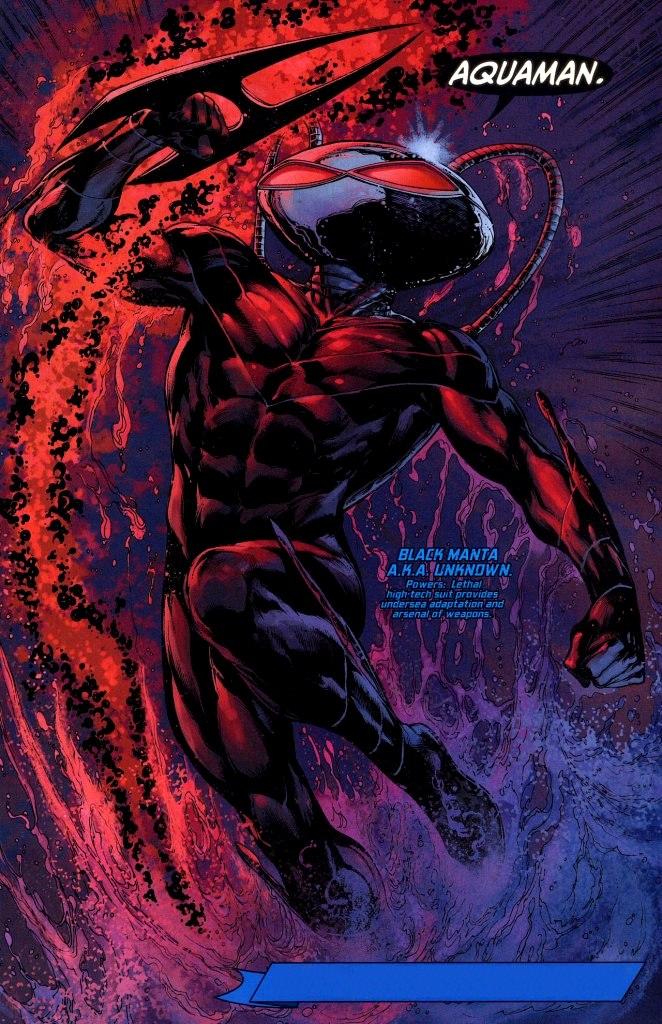
Admit it. Everyone thinks Aquaman is a joke.  The New 52 provides him a means to drop all the baggage of his history and start fresh.  So it is that with Aquaman #0 we see a story from his life where, prior to heroics, he's simply confused and angry about his questionable heritage and seeks out his first answers.  Under the sea.  In many ways the art of this series has been a major selling point, serving the story to such a great capacity that if it was a lesser artist would have killed the baby in its crib.  As things stand, Aquaman has come to a point where you can relearn his history without knowing the phases of "hand/not hand", "hook", "bionic hand", "sea god powers", "king/not king", "moody", "useless", "dead"... and reinforce his ongoing animosity with his half-brother Black Manta.  He's depicted too variably in what few other New 52 titles he's appeared in, but with this series, he's less out of his element, pun most certainly intended.  So long as they keep reminding people that the art sells the story in Aquaman and less the other way around, everything for this title should remain relatively kosher. Ha. Kosher. Get it? Alright.

8/10


X-TREME X-MEN #4
Writer: 
Greg Pak
Penciller (cover): 
Kalman Andrasofszky
Artist: 
Paco Diaz


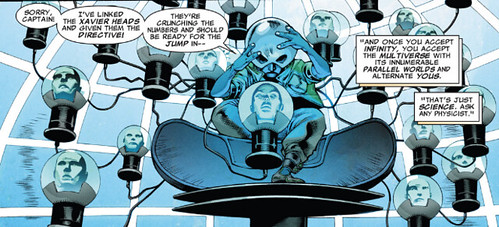
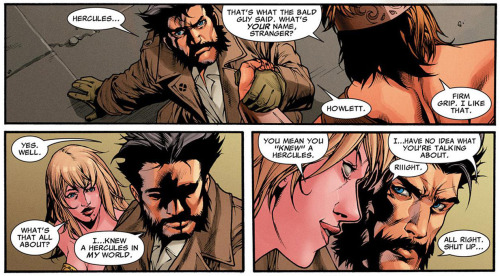
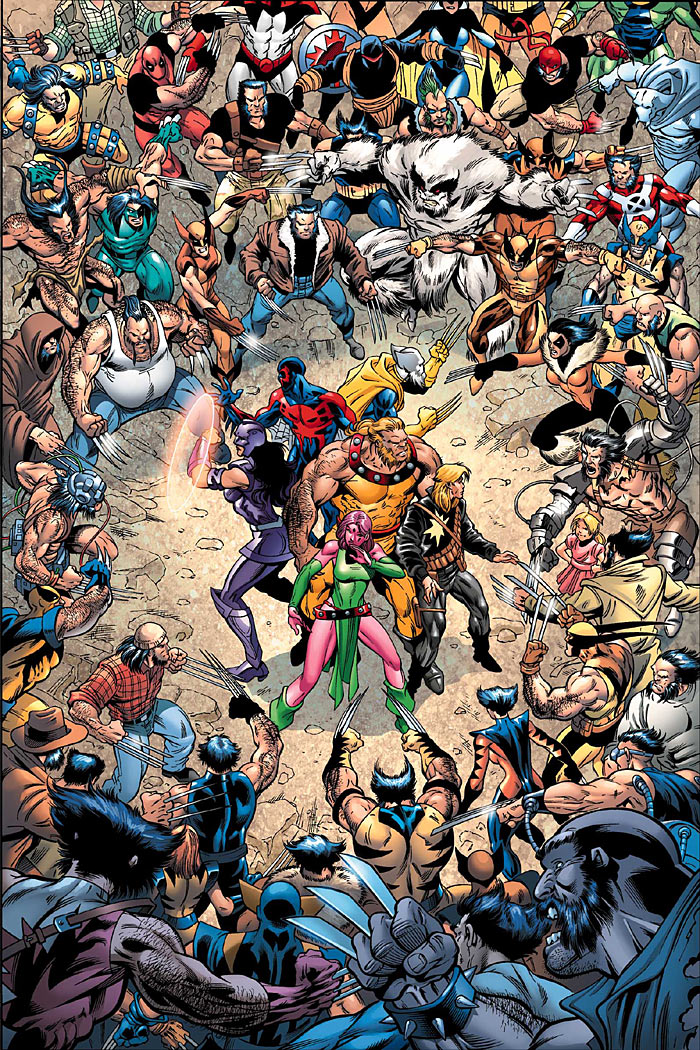
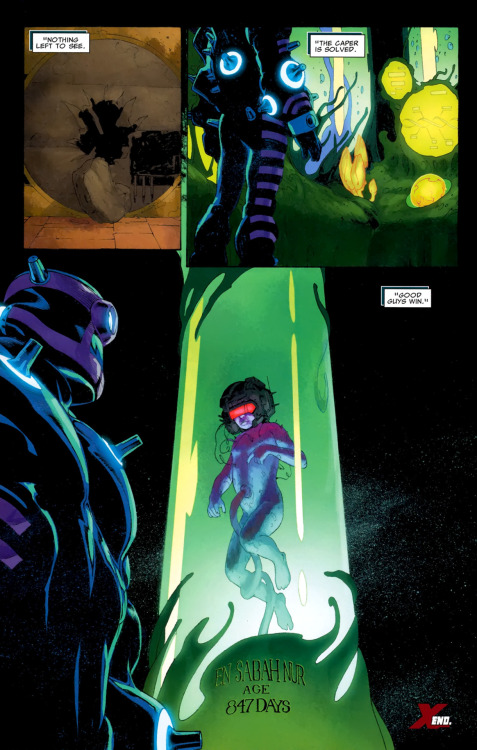
You'd be better off forgetting the Chris Claremont brain-child X-Treme X-Men that emerged from the sewers of Marvel around the same time as Grant Morrison's New X-Men.  The new title X-Treme X-Men follows a group of characters that first appeared in Astonishing X-Men, playing alt-reality foils to Lawful Neutral Cyclops in a reality where Charles Xavier is a bit of a dick-head. Then they reality hop, apparently along the lines of the little-loved but potentially fabulous Exiles series.  With X-Treme X-Men #4 the team, if in fact it can be called that, consists of a Charles Xavier head in a floating jar, James Howlett, Dazzler, and an alternate reality Nightcrawler (common since his death on Earth 616) and they team up to... well, it's hard to say. "Kill about a dozen evil Xaviers" fits, but it's an "episode to episode" scenario in many aspects, the true overarching goals unclear at a glance but hey, who cares?... Feels like the old series Exiles mixed with Sliders mixed with Quantum Leap, to an extent, and just like Exiles it's very mutant-heavy in all respects.  The art and the general "just go with it" attitude of the title overall save it from falling into the realm of being too snide or overly hokey.  If every two issues or so we get to see this reality-hopping crew have a random encounter or three, it should make for neat cover art at the very least.

8/10


RED LANTERNS #0
Written by: 
Peter Milligan
Art by: 
Ardian Syaf
Vicente Cifuentes
Cover by: 
Miguel A Sepulveda


Let's just say you don't want to be a jaywalker when the Manhunters decide to get feisty.  What has come as a pleasant surprise is that the title Red Lanterns has survived as long as it has.  It showed a strange sense of potential, twisted as that may at first seem.  Atrocitus, the first Red Lantern, provides explicit details of his motivations and origin with Red Lanterns #0.  Also, it turns out that he had relations with a demonic space squid, and learned the lessons of the Five Inversions, using their bodies to craft the Red Lantern battery in the first place.  These and other details are filled in that should prove of interest to both new and old fans of the Green Lantern stables of stories.  Overall, this issue shows the complications of a character you might expect in a Lantern whose primary motivator and power source is rage. Though not inherently evil, but more inherently brutal, the red end of the spectrum seems motivated by injustices rendered by figures of authority, and with the recent and blatant abuses of power rendered by the so-called Guardians of the Universe, along with the removal of Hal Jordan and Sinestro from the board, war is almost certain.  They'll be calling it the Rise of the Third Army.  This issue plants seeds for that and more, and although rushed in some spots and wordy in others, sports a certain confidence overall, which leads to a stronger fan base in the long run.

7.5/10


WOLVERINE #313
Writer: 
Jeph Loeb
Penciller: 
Simone Bianchi


This whole mess sucks. I'll get to this review when I am done wolveretching. God. Such a terrible taste in my mouth.

Really, how many times will Wolverine nearly kill Sabertooth?  Kids shelled out good money to see him decapitated once and for all, heck, there was a hardcover copy and everything. A clone killed Feral, is that what you're saying?  And this Romulus and Remus thing that we're led to believe was behind even what was behind the behind of Weapon X program?  

What's so effin' difficult about writing a Wolverine storyline? Sure, send him to hell, okay.  Let demons take over his body.  Then hem and haw over him dealing with the same tired pattern, maybe throw in a Gorilla detective for comedic relief, or gross everyone out with yet another hint at his mysterious past and shit, fine, you know what? Don't care.  Stopped caring. Wolverine should be dead from overexposure by now. He's impossible to kill by virtue of his popularity, okay, we get it, but you can write a story without it being about something fifty to four hundred other people have already done.  Mark Millar got it right, and that was ages ago.  Since his revelation of memory after M Day, we've had Wolverine run ragged joining the Avengers and becoming a headmaster of a new school and being featured in his usual six to ten guest star spots either subverting his classical image or tritely attempting to make it more shiny.

At the end of the day, this most recent plotline is to make us believe that Logan, James, whatever you want to call him may have volunteered for the Weapon X project, used to work for Romulus and Remus, and bladdah bladdah forget anything you knew before, let's change the ending to something besides a faked alien threat, yeah, let's make it, um, Dr. Manhattan bombing the world, sure, let's dumb down the whole thing like a Zach Snyder feature and end it with him kissing the hot immortal redhead or whatever, Christ, fine, do it.  Get Jeph Loeb to do this series forever, let him turn Wolverine into an actual wolverine. Yeah. Team him up with Liefeld and a team of cancer monkeys. It's over. I'm done with it. Wolverine's officially jumped the shark, folks. Nothing to see here.  

Art for the past few issues with this effrontery against all previous issues has been fantastic. That's it. That's all that's even remotely good about it.  Even then, to be honest, it just makes me nostalgic for old back issues of Heavy Metal. Let's strike these past three issues from the record. Bury them like E.T. the video game. 

4/10

Monday, July 30, 2012

Mainstream Reviews for Recent DC Releases


BEFORE WATCHMEN: MINUTEMEN
8/10

Not sure if Meta or simply well-played nose-thumbing.


Here we have a dilemma.  There are poignant ways to go about the process of homage, and it's a rare and delicate thing that DC Staffers or Corporate Masters have in mind for the controversial Before Watchmen series.  True, characters and plot-points in Watchmen were themselves derivative from previously created characters, and thus beholden to similar strictures of critique, but that is not to say that they are beholden to the exact same strictures as this series, indicative as it is of a more common malaise in this day and age: prequelitis.  

It's a polarizing issue.  On one hand, it seems like DC is cashing in, and some fearful pundits point to the injustice of Moore's (if not Gibbons) legacy being besmirched by inferior product. Another argument goes something like: "If the creator or creators of the project don't like it, they should look to how bad their predecessors had it. Besides, DC owns the characters, they can do as they like."  On yet another hand, there is admittedly rich territory to mine in the mythos that Moore laid out, perfect and self-contained as it is.  

This series was inevitable, however dubious it seems.  

I recently passed a copy of the graphic novel Watchmen to someone that had never read it before.  Our conversations concerning plot and character were in depth and appreciative of the aesthetics inherent in the comic's structure.  It's still a classic and deserves a classic's respect.  It's interesting to note that Alan Moore's manner of approach was then and in many ways still is a righteous example of the medium's potential unleashed. Pacing, segue, and breathtaking detail combine to create effects no camera could hope to capture, and no future savant could properly match.  This new reader asked about the movie, and then I told him about the Before Watchmen project, as magnanimously as possible. He then made the next logical cognitive leap and likened the project to Lucasfilm's dreadful prequel trilogy.  To an extent, he has a point, but the qualifier from the project, ambitious as it is, is this.  Each of the series are self-aware to a fault, and their style is distinct to each creator.  

The talent called out for these projects is solid.  The characters are familiar enough to the legions of fanboys turned pro calling the shots that a justifiable love becomes apparent, even if it can't match the stark intensity that Moore's project possessed.  There is plenty more to be said, but for the sake of some sense of brevity and in the interests of keeping from straying into either malignant critique or sycophantic praise, I'll give that the best example of the potential for the various series (thus far) is Before Watchmen: Minutemen, written and drawn by Darwyn Cooke.  Cooke's style is best suited for this particular trip back in history, with DC: New Frontier preparing him quite well for bygone idealism gone sour.   


JUSTICE LEAGUE OF AMERICA 11
7/10

Justice League of America, still in-fighting after years of teamwork and struggle. I'm falling asleep now.


Tedious splash pages and uncharacteristic actions lend a hot-headed spin for the whole team in Justice League of America (JLA).  The more I read JLA the more distant I feel from the characters I had become accustomed to for so many years, and more frustrated with their less charming simulacra.  My first true JLA experience was the first issue of Grant Morrison's supremely refined run, which took in all running plotlines at DC whole cloth and spun a series that lasted through multiple cosmic crises, without missing a beat on who these characters are.

More than archetypes or stereotypes, the heroes of this particular group need to personify the super aspects of their superhumanity, with their years of experience backing up their every action, while embodying the human side in as elegantly as possible.  Stories with the universe's big guns need to reach far and they need to matter.  Instead, the plots plod along with no sense of potential as a crew of people that still don't seem to know each other at all simply deal with and react to matters that possess no sense of history or weight.  There's no drawing out of tension in the story, feeling like an overproduced jog through styles.  It often seems an excuse to needlessly splash-page, and smacks of Jim Lee's influence far more than the minutiae macro-scripting usually provided by Geoff Johns.  The first part of the series involved an invasion from Apokalips that occurred "Five Years Ago"... but what's actually happened in the time between then and now? Blackest Night? Brightest Day? Final Crisis, certainly not. Final Night? Zero Hour, perhaps, but Crisis on Infinite Worlds? Has Superman died? Did anyone even care? Who knows? I understand the draw to "here and now" the New 52 seems dead-set on, but what's happened in the past five years in the New DC Universe?

It seems the new reader gets less bang but more importantly the years-long loyal fan hasn't got much to go on, either. The entire team bickers and plays out their roles like rusty parodies of themselves.  There seems to be no breathing room for personalities in the larger-than-life splashpage world, so each character degenerates into their roles as near-stereotypes fused with near-archetypes.  Flash seems overly timid, while Green Lantern seems little more than a jock with a ring, whereas Superman is more like a quiet boy-powerhouse than a force of nature, and Wonder Woman is an unapproachable too-foreign hothead.  Batman? Oh, he just slinks around commenting on what useless twats he's working with, not much use or insight.  Cyborg practically runs the show in terms of being a linchpin of the team's dynamic, their teleporter, their go-to guy, but even that feels forced.  Perhaps Geoff Johns (and even a fan or two) remembers that the real linchpin of the team was and always will be the Martian Manhunter (we get only a brief glimpse of the one time the JLA attempted to recruit him, a two page firefight, but maybe since he's recently ditched Stormwatch he may yet show up again).

Recent arcs are general and truncated awkwardly. There's a "new" villain with a vendetta against the team, but the vendetta is vague and silly, his powers emotionally manipulating but ultimately empty, because the punch they're supposed to pack relies on content that no reader of this series actually has (yet, I know, yet).  This is the fundamental flaw and underpinning critique I have for the series (at this time).  Perhaps one sticks with this series in part out of a pouty nostalgia and partly in vain hope that the comic might accomplish a difficult task: feeling something for these newly-minted replicas of characters that knew and understood one another in a discarded universe and have had years, decades, almost a century of history together, up in a puff of comic fluff.  Perhaps what I want out of this series will take years to get to, or perhaps in the attempt to please everyone punches are pulled by editorial restrictions.  Johns is a long-haul writer and a capable scribe, so perhaps forthcoming events will shape/round out the missing back-stories, or maybe, just maybe, issue zero won't seem like filler.


DIAL H 3
9/10

It's all a conspiracy. No, really. Kinda. Mostly.


Complex, quirky, and variable, we have a comic here in many ways like a strange gem with a spirit of Bosch inhabiting it. Dial H is one of the more fascinating new series to emerge from DC's stables.  When a fat chain-smoking schlub named Nelson Jent uses an alleyway pay phone to get help for his friend (who fell in with a real bad crowd), he accidentally dials up powers from a vast array of quirky characters.  Bitten by a radioactive concept originating from the 60's wash of surreal characters (the original Dial H for H.E.R.O), the series has a bent to it that reminds one of Morrison's old Doom Patrol run, while simultaneously owning the bits of backstory that new readers and even some old readers are likely ignorant of.  The story by China Miéville explores a ground-level classic format, that unfolds like Japanese origami to reveal layers quite unexpected.  The protagonist, Nelson, plays out a perfect down-on-their-luck fool, and we root for him against all opposition, which itself truncates and expands and gains texture as the story plays itself out, in simple and complex strokes.  The art by Mateus Santolouco is a perfect compliment to the progress of the plot, intriguing and complex enough to revisit again and again.  Each character presented is so weirdly bent and surreal you have a giddy expectation of the next transformation. A fun read, and self-aware enough to pull off what seems at first blush to be silly and atonal in nature.

Thursday, May 17, 2012

Dealing with the Overman: Brief Notes for a greater treatise regarding Superman the Icon


In this work, we will examine the icon of Superman, the first comic book superhuman that stuck.  We will also take a look, in somewhat chronological order, at the correlations, commentaries, and myriad takes on the mythology that arose around this concept.

We'll start with Superman, the infant sent in a rocket from a doomed world, raised by a childless couple in the American heartland of Kansas.  He first exhibited his abilities from a young age, leading to his gradual growth into the persona of Clark Kent, mild mannered reporter for The Daily Planet.  His creators, Jerry Siegel and Joe Shuster, had no part in anything but the scantest part of the tremendous capital generated by Superman as a phenomenon, translated to moving pictures and countless streams of merchandise, far outweighing any competitor by sheer force of presence as an icon.

Years pass strangely between comic books and the real world, and after spawning a swamp of imitations and assimilating those that even came close in appearance (Captain Marvel of Shazam! fame will be explored shortly), Superman finally found his nemesis in a Kryptonian-bred superweapon known as Doomsday.  After his death and the subsequent universal re-imaginings of DC Comics, he is today another creature altogether, but pausing along the timeline at All Star Superman and the Final Crisis crossover, organized and largely written by Grant Morrison, we find a bleeding-edge meta commentary to the quality of the work, referencing the many worlds and timelines where a flying caped hero with invulnerable skin and a strict moral code to protect the innocent can be found hard at work, saving the universe and the multiverse.


Interestingly, one of the heroes from an alternate reality that Superman meets in his adventure with other "supermen" was Captain Marvel, a hotly contested lawsuit-settlement-won character from the earlier and more litigious days of DC Comics, then known as National Comics.  Captain Marvel,  created by artist C. C. Beck and writer Bill Parker, started out as Captain Thunder (later used for a 1980's African-American iteration) and then Captain Marvelous. His similarity to Superman beyond a superfical level was always nil, but after years of devastating litigation, Fawcett Comics settled the matter with National once the case was bumped back into lower courts.  His character was transferred to the DC stables, represented as having magical powers, standing in place for a little boy with a alliterative name whenever he spoke a magic word.  The cutting off of Captain Marvel comic books to England gave rise to Mick Anglo's Marvelman, but more on that in a bit.


Superman Beyond 3D represents Grant Morrison's ultimate take on Superman's mythology, putting into story a universal formation around the pearl of Superman, in fact a construct in a multiversal orrery, a doomsday weapon to fight a cosmic vampire.  In Superman's group of Monitor-collected alternate reality companions, we find the aforementioned Captain Marvel, Ultraman (a psychopathic reverse-world version of Superman), Captain Adam (a superman with interesting correlations to Doctor Manhattan from Watchmen or Captain Atom from the New 52), and Overman, the requisite Nazi Superman.  It is here, as well as a moment in All Star Superman, that Grant Morrison draws directly from Nietzche to reinforce his meta-commentary on the iconography of the Superman.

In Thus Spoke Zarathustra, the Übermensch, or Overman, holds a position in Zarathustra's presentation as the creator of new values after the twilight of piety and nihilism that man stews in. The Übermensch forms a new moral standard, well apart from the squabbling infestation that ordinary man, in his eternal ignorance, helps perpetuate.  It is here that the development of the superhuman standard can be seen at work in comics, moving beyond dot matrix printed slugfests and soap-opera dramatic back doors, into a more philosophically varied position of moral development.  In essence, mankind is something to be overcome, and in our attempts to understand ourselves we may form a creature that sees us as a laughingstock.  This mirrors the attempts in recent years of comic books to validate their own existence and prove themselves more than they once were, beholden to a higher standard than initially expected.


To the end that Superman was and will always be an icon that draws in a goodly sum of cash, ebbing and flowing given standards of society, it would make sense that the creators at Marvel Comics, mainstream competitor to DC Comics, would at some point capitalize on the concept in their own fashion.  The result was Hyperion, Marvel's first answer to Superman.  Created by Roy Thomas and John Buscema, this provided a leader for the Sinister Squadron, arguably a villainous Marvel-looking glass take on the Justice League of America, designed to fight The Avengers.  An alternate reality version of these villains were also created by Thomas and Buscema, the Squadron Supreme of Earth 712.


However, in the years following George W. Bush's horrific first term in office, Hyperion resurfaces, this time an Earth-31916 version.  J. Michael Straczynski and Gary Frank craft a superhuman that crashed in a similar fashion to Superman, but the kindly couple that discovers him never gets a chance to raise him.  Instead, the U.S. military puts him in a foster home with the expressed intent to develop him as a superhuman weapon of mass destruction.  When, inevitably, this Hyperion breaks free of his imposed position, the military meetings describe his capabilities for murder in Megadeaths.  This imagined graphic carnage is jumping a little ahead of ourselves, hearkening in some ways back to Miracleman, who we will now address.


For all his personal foibles and fables, Alan Moore works at his best when he is reworking the concepts of other creators, tweaking and paring down the essence of a character he did not himself create.  No better example of this than the little-seen Miracleman, first known as Marvelman.  As previously mentioned, the gap left to Britain with the passing of Captain Marvel Comics out of circulation was filled by a blonde imitation courtesy of Len Miller and Mick Anglo, just as wholesome as the Fawcett creation yet distinctly more British.  The origin story was tweaked (astrophysics replaces magic) and the series went on to great success, even in Italy.  Years down the line, a British comic book called Warrior was printing Mick Anglo stories framed by a story Alan Moore developed out of the original content, creating yet another interesting metanarrative, and perhaps the first of its kind within superhero comics.  The reality of previous continuity was in fact a virtual reality simulation concocted by an evil scientist who reverse engineered the "Miracleman family" from a fallen spacecraft.

The storyline for Miracleman consists of too many ground-breaking moments in superhero comics to go into in the space we are provided, but suffice it to say, much as Moore's later work in Watchmen, Miracleman proved to be a game changer when it first hit the industry's bigger editorial bullpens.  After decades of work inside and out of courts, it was announced not too long ago by Joe Quesada that Marvel now officially owns the rights to the stories, although given Moore's current standing and reputation in the mainstream, his work, along with a nascent showing by Neil Gaiman, may never see the light of day, proper.  The crux of the series must be noted, however, as Kid Miracleman, sidekick of Miracleman, speaks his secret superhero word while being sodomized in a school bathroom, then goes on a killing rampage in London, at superspeed.

Here we see a grandiose act of terror resulting in very distinct loss of human life on a grand scale, but moreso, on a superhuman scale,  still not topped in terms of graphic wholeness in any comic to this day, at the hands of a deranged superhuman reverting to the basest of human instincts, the direct opposite of the morally refining/annihilating Overman.  Miracleman tricks Kid Miracleman into saying his name, then snaps the neck of the inner host child, sobbing in the ruins of London.


What Moore went on to do with Miracleman was take the step towards superhumans tactically rearranging the world's affairs to the next logical level.  But with his work in Watchmen, we see only one true superhuman in a world where moral quandries are the norm, and human affairs muddled.  Dr. Manhattan is Alan Moore's final commentary on the superhuman.  Taking elements of an old episode of the Outer Limits for the overarching plot and this character's personal microcosm, mixing some of the chrono-synclastic infundibulum experienced by Winston Niles Rumfoord in Kurt Vonnegut's Sirens of Titan, and throwing in glowing blue for good measure, Dr. Jonathan "Jon" Osterman is a being that stands outside of time.  The morality of his actions escape him early on, and he's used as America's nuclear deterrant and the solution to the Viet Nam conflict.  His seemingly infinite power is undercut by a lack of emotional perspective, brought back into play only through finding interesting correlatives within human bonds, via his lover the Silk Spectre.  In the end, he leaves the world to "create some life of his own" and reverberates in comics, in all his blue nudity and glory, to this day.


Along the lines of interpersonal relations, when Warren Ellis formed the wide-screen superhero team Authority in the late nineties, he brought on two petri-dish experiments known only as Apollo and The Midnighter, homosexual tangents of Superman and Batman.  Outside of his role as solar-powered strongman, Apollo's character depth never developed a comfortable and personable niche, although he did end up in a collection of the multiverse's "Superman Squadron" in the final issue of Final Crisis.  Not flamboyant but certainly a controversy to some small minds, at the present moment Apollo represents a social commentary regarding the status of the Superman iconography. His costume's triangle could clearly be seen as a direct reference to his homosexual status.  Not often has the issue come up, but with the recent revamp of Apollo into the DC mainstream, it will be interesting to see how DC might handle him potentially being "outed" in the future, or how social norms mind lend him some room to build actual personality in the momentum.


Another take on the idea of Superman's iconic status is Omniman, from the comic by Robert Kirkman known as Invincible.  Omniman is a soldier of an empire of superhumans, Spartan-like and merciless in their expansionist scheme.  He bred with a human and had a child, the comic's titular teen hero, and is outed for murdering the "Justice League" proxies of their Earth.  His character represents an extreme of old-school humanity, his people all being combat-oriented dominators, first and formost.  He's a wolf in sheep's clothing, or worse still, a wolf in a herd-dog's clothing. It should be noted that Dragonball Z might have some influence on this title, though it cannot be directly confirmed at this time.  In that long-running  anime series, the central and most moral hero Goku is initially sent to Earth to clear out the population for his race of war-hardened Saiyans. They, much like Omniman's Viltrumite race, become more powerful the more they fight. Omniman develops a conscience in the midst of fighting his son after being found out as a villain.  He, more than any other character in the Invincible series (a cast of hundreds), undergoes a radical moral conversion and develops interestingly as a character, the more human-like he becomes.


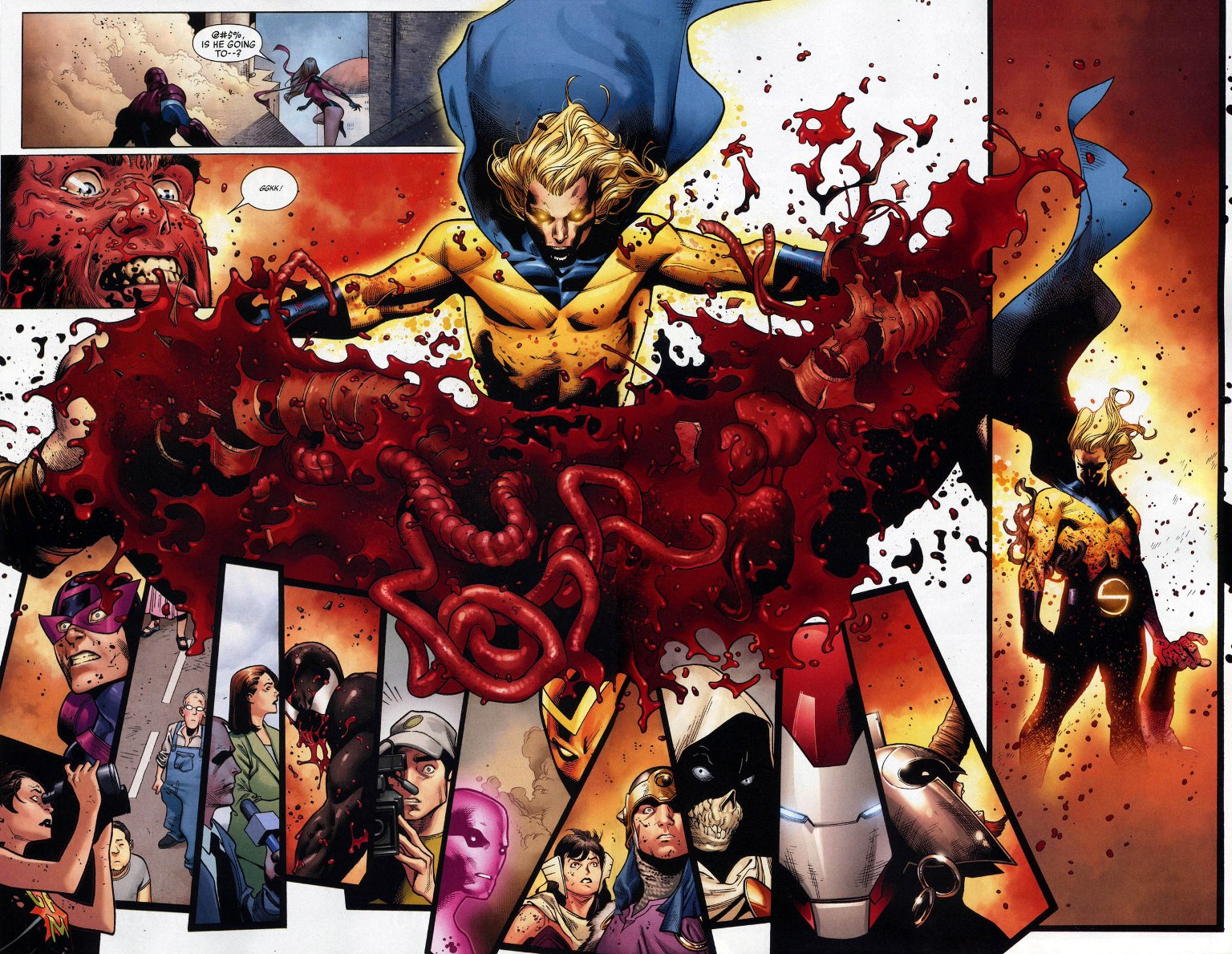
A Superman-shaped flaw in the Marvel Universe worked itself out as a character named Sentry, created by Paul Jenkins and Rick Veitch, originally pitched as "an over-the-hill guy, struggling with addiction, who had a tight relationship with his dog, and also was a guardian type, with a watchtower."  Sentry insinuated himself into the Marvel Knights line of comics, a realm between mainstream and Marvel MAX, and retroactive continuity placed him as a creature with a scope of powers akin to Superman's that struggled with a duality within himself known only as The Void. His very presence became increasingly unstable, as he fell as pawn and puppet to the Green Goblin.  He murdered the gods Loki and Ares in an assault on Asgard, and begged to be put down.  Thor threw him into the sun.  His background, a muddied mix of over-the-top power and under-performing subplots, lent him an unstable mix of characteristics. He tended to blend into the background or overpower any foe he faced, with little actual characterization in-between. With the giant S on his belt buckle and the mental illness he dealt with on a day to day basis, he was difficult for readers and heroes alike to relate to, but his story once again hints at the frailty of the superhuman dynamic in the face of lesser human manipulations.


This plays itself out once more in Supergod, a comic put out by Avatar Press and written by Warren Ellis, with art by Garrie Gastonny.  In the way Warren Ellis put it, Supergod was meant to depict what an actual superhuman arms race would look like.  It escalates quickly and smacks of the old ultraviolence.  It was also a frank commentary on the human trait of identification and deification, side by side with weaponizing technologies that we can barely understand given to creatures so inhuman they crap radio waves.  This bleak world shows nations running secretly funded projects to develop not just the next level of nuclear destruction, but a god to worship.  Ellis explores the absolute amorality of the subject with the dry wit of a brilliant drunk in an English pub. The issues of transhumanism and posthumanism skirt the edges of the bloodbath and planetary havoc that is wreaked in the course of the story, but again, and this would seem to be a recurring theme among the standards and practices of superhumans in these different permutations, it's the core of man's goodness that is returned to, directly before complete annihilation and assimilation into fungal eternity.


The Boys, written by Garth Ennis and  illustrated by Darick Robertson, is an insider's send-up of the ridiculous nature of superheroes, while at the same time more black humor commentary on war, politics and corporations.  The closest Superman-type we can find is the blond puppet known as Homelander, a government bred experiment, terribly flawed in execution, who in recent issues went berserk and killed every person in the White House.  The Homelander is parody of the bleakest sort, a living breathing confrontation of the ineptitude of certain government officials concerning 9/11, a tarnished Aryan bootlick draped in an American flag and given no social conscience.  His berserker rage was started when the deterrent designed to stop him if he ran amok (a clone of him, in fact) posed as him doing horrific acts to innocent families, to trigger him and fulfill its purpose.  Manipulated from start to finish and given only the slightest redemption after being soaked in presidential blood, the Homelander is so distantly removed from Zarathustra's tulpa what became Superman we could almost laugh bitterly when comparing the two, which is of course the point. Garth Ennis has sent up this sort of parody flag before, with a character known as The Samaritan in his comic The Pro, illustrated by Amanda Conner.    


After all exhaustive inquiries into this realm of material, the well has not run dry.  Mark Waid's Irredeemable, in his own words from 15 Minutes with Mark Waid: "What if you go from, you know, Captain America to Doctor Doom? What if you go from Superman to Lex Luthor? How do you go from being the greatest hero in the world — someone that everybody knows, and everybody loves, and everyone recognizes — to the greatest villain in the world? What is that path? It's not a light switch, it's not an on-off switch, it's not something that you wake up one day and just become evil."  Here we have an idea running counter to the stable "silver age" sensibilities that some would have once accused Waid of (addressed by Grant Morrison in a Foreward in the first Irredeemable trade paperback).  The Plutonian is a character whose origin involves cosmic happenstance, infanticide and repeated attempts at infanticide, then an orphanage and numerous failed foster families.  He is a frustrated superhuman that finally gives up after taking years of overhearing snide remarks from people he saved and, once he works up the nerve to reveal his secret identity to his girlfriend, watches as she tells the rest of the people at the radio station they work at.  He turns utterly evil, murders an entire city, then sinks Singapore, all while hunting down old allies and enemies and systematically exterminating any human that talk about him behind his back (a benefit and curse of super-hearing).  The story moves along and he is stopped, thrown into an intergalactic insane asylum, meets his cosmic parents and evolves, but still remains unredeemed.  He stands in stark contrast to one of his former villains turned hero, Max Damage, featured in Incorruptible, also by Waid.  Here we have the unfolding and destabilization of the Superman mythology and indeed an exploding of the Overman application to comic books altogether.  Nihilism compounded with superhuman abilities, tinged with impiety.  Super-psychokinetically charged pettiness and rage do not make for a character worth saving, most days of the week.  Hence the title.


We might conclude, given the nature of the material presented here today, that the role of a Superman-type in the comic book industry has lost  some of its moral fiber and gained some realistic turpitude.  The easy answers of times gone past are no longer permissable.  Once we begin our descent on the slippery slope that these cascading permutations allow (and here we have not even named all), we can fall into endless speculation on the scope of this or that plotline if inflicted on reality's fabric, and this or that moralistic spin on the caped invulnerable hero.  The New 52 released by DC Comics gives us Clark Kent's parents only in flashbacks, as they are dead in present time, and this is a shame, though likely new books featuring these heroes behind the hero could come up.  These two, Jonathan and Martha, are the very center of Superman's moral code and immanence as superhuman perfection.  Lending somewhat to the nurture vs. nature argument, we can see that all the good of Superman comes from his grounding in what makes him a man.  His code of conduct, far from being imposed by another authority, comes from an understanding of human nature instilled by his parents, along with an unflagging optimism, a certainty that good will triumph over evil, that the petty squabbles of mere mankind can be overcome, and that in the end, however trite it may sound, the Overman may in fact dwell within us all.


[A final moment, a brief comment, an afterword, concerning the development of a character in the Marvel Universe using the presupposition that Superman's parents are the core of his higher moral standing.  Apocalypse has traditionally been a villain, repeatedly ressurecting to fight in the various books concerning mutants in that universe. His relatively recent death at the hands of Weapon XIII, Fantomex, while still just a child, were offset recently to some degree.  A clone is placed in a virtual reality containment unit (mirroring Miracleman's VR existence), where he is raised by a simulated mother and father, "Ma and Pa" on a farm in Kansas (obvious relations to Superman's origin via Baudrillard's Simulacrum and Simulation).  He is taken out somewhat early from this simulation and set to fight against Archangel, the heir apparent to the legacy of Apocalypse.  Given the codename Genesis, he is currently attending the Jean Grey School of Higher Learning, where he is just beginning to question his origins.  We can extrapolate that his turn away from morality might come when he learns that his childhood and family were a fabrication of some faux French anti-hero.  What better means might one deal with this potential omega level threat simmering on Marvel's backburner?  Could Genesis, if he had followed the simulation to completion, have become redeemed for all the evil done in the name of Apocalypse?  There are many things still to be said for the mythology that Superman gives us, and they will be explored so long as man is still committing ink to paper (or pixels to screens) in the name of comics.]