Click!

Showing posts with label Marvel Comics. Show all posts

Thursday, February 28, 2013

One-Line Reviews for Recent Titles


AQUAMAN #17
Written by: Geoff Johns
Art by: Paul Pelletier and Art Thibert
Variant Cover by: Paul Pelletier, Art Thibert

Steadily, the New 52 DC Universe has carefully hedged its bets with Aquaman, a bad joke given good substance, and the results come through in the story by Geoff Johns and the beautiful care taken by Pelletier and Thibert. 

8.5/10


ALL-STAR WESTERN #17
Written by: Justin Gray and Jimmy Palmiotti
Art by: Moritat
Backup Art by: Staz Johnson
Cover by: Bill Sienkiewicz

The DC New 52 has given new life to the Jonah Hex franchise (and the western comic genre) with All-Star Western, but the real treat comes in the expansive unfolding of DC's old west universe, under a variety of talents.

8.5/10


BATMAN INCORPORATED #8
Written by: Grant Morrison
Art by: Chris Burnham


Though this issue moves at a break-neck speed, marking the death of Damian Wayne, Batman's sidekick/son, the scenario seems too contrived and falls flat, a rare bad note in Morrison's symphony, nonetheless beautifully rendered by Chris Burnham.

7/10


THE FLASH #17
Written by: 
Francis Manapul
Brian Buccellato
Art by: 
Francis Manapul

Since he reshaped the entire DC Universe by running really fast (again), Barry Allen has been having establishing shot adventures in his hometown, most recently concluded here in his battle against overly intelligent primates (again), but the stale material of pre-chewed storyline is competently handled by Manapul and Buccellato, while the art shows new potential in the formalities.

8/10


AVENGERS ARENA #5
Writer: Dennis Hopeless 
Cover Artist: Dave Johnson
Artist: Kev Walker  

The second-rate villain Arcade has redesigned Murderworld to thin out the Avengers Academy by forcing them into mortal battle with one another, which seems like a tired premise and would be if not for clever character development by Dennis Hopeless and near-perfect visuals by Dave Johnson.

9/10


UNCANNY AVENGERS #4
Writer: Rick Remender
Penciler: John Cassaday
Inker: John Cassaday
Colorists: Laura Martin and Larry Molinar
Letterer: Chris Eliopoulos
Editors: Tom Brevoort and Daniel Ketchum

The extension of the Red Skull's plot to pit humans against mutants presents the first major threat to the newly integrated team of Avengers that include Havok, Rogue, and the Scarlet Witch; the solid script by Remender and award-winning artwork by John Cassady make this book a high-quality treat. 

9/10


UNCANNY X-MEN #2
Writer: Brian Michael Bendis 
Penciler: Chris Bachalo 
Cover Artist: Chris Bachalo 

With the new relaunch of Uncanny X-Men, we see a disgraced and power-fragmented Cyclops attempting to assemble a school for wayward teen mutants in the hope of defending themselves against the various threats of humanity, given weight by Bendis and sculpted by Bachalo.

8.5/10


YOUNG AVENGERS #2
Writer: Kieron Gillen 
Artists: Jamie Mckelvie with Mike Norton


Kieron Gillen delivers a no-frils superhero team comprised of a younger generation of interesting characters, and Jamie Mckelvie and Mike Norton are having a good time with narrative design, in terms of asethetics, making this a surprisingly impressive exercise.

8.5/10


Thursday, January 3, 2013

On the Nature of the Industry: Free Association.

Where Mutantkind's Utopia has produced a GMO seed to wipe out world hunger, you can bet Monsanto's watching.


Remember, Comic Books are Big Money now. 

It's gotten to the point that it's lazy to even allude to the tag line ("Comics are not for kids anymore") so frequently and freely repeated as an introduction by lazy journalists over the years for their hum-drum research of the new mature themes expressed by the once-chemically-castrated medium. It's an industry joke to just say comics aren't for kids.  When were they last for kids? Unless you're talking baby goats, there are no more kids. The Internet is raising this new batch as the Television raised those of us born into the ad-blasted 80's, and none of them are children. Even the simple reference parenthetical presented here is simply to conjure the final nail in its coffin, on a tapestry of blog blubber. 

Nobody gets to use that term which shall not be repeated.  Anymore. Ever.

Your average mainstream comic book is for two kinds of people. Teenagers and people with the same interests as teenagers (though, in Reality a divergence of sex and age and status ever-expanding, providing a common watering hole of nerd culture expressed in 10,000 neon Pokemon balls of media, much of it becoming interactive in a new and initially awkward way, most meeting the aesthetics ranges expected from medium to major overweight/out-of-shape/ malformed/ mutated service industry hopefuls). Intangibles emerge immediately. The service of these forms is exemplified in the minute variance of theme available  (many notable exceptions notwithstanding) in mainstream comic book media. The Gangster Ethics that Alan Moore describes prescribes a thuggish glare to the industry that often accompanies fame for these age-old standing standards of character, or lack thereof. These are stories that most often struggle with the idea of the Hero's Journey, attempting to subvert or integrate it through the use of panels and script.  

Heroes are heroes, but the Big Two share a copyright on "superhero" so that is, for the most part, what they have made a point of presenting over the century or so since the medium was first developed in a Yiddish fever dream, and these garish supergods spilled from our third eyes and onto our experiments in the second dimension, where the ink still boils... but the concept of superheroes is off-limits, technically. If labeling a superhuman creatively,you generally have free reign to call them metas. Or mutates. Mutants has the X connotations, another trademark alley exchange. Superhuman is itself an adjective, it is the act of being super in your heroics that everything breaks down. Superheroes, Heaven forbid anyone get hold of that outside of the rigid patriarchal monotone conditioning of a company in the tender clutches of a media conglomorate. 

You'd think it'd get tiring after a while, but comic books  draw from and speak to something primal in our psyche and by extension culture and society that no other medium does with quite the same smirk in your mind's eye. As Grant Morrison noted in an interview with the Onion A.V. Club, the combination of text and image on a page presented in a sequential format creates a hologram in the mind of the reader. 

When one reads a comic book, as much as if not more than in the instance of a standard novel, there is a creation of voice and noise where there seems to be only silence, but moreover there is a sense of image and movement that cannot be replicated in any medium, something to do with a thing McCloud called "the gutter". Moore has a great deal to say on the topic as well, in The Mindscape of Alan Moore, but we don't have five hours here to get into the intricacies of that (for now). Let's look at the history first, being mindful that comic books are a wholly unique medium that stand apart and in several cases above all other media, in terms of human collaboration, internal exploration, and general aesthetics.

It's due to the auspices of panicky McCarthyism that the mainstream superheroes we're just now coming to terms with in Megaplex Excursions were born. Developed in this Era of Cold Warriors, the Comics Code Authority was like a vice-grip on the balls of creativity, for the "sake of the children", which immediately infantilized the medium as a whole. A sense of surreality in culture was expressed in the acid-washed sixties of loose hook-ups and rainbows of irony and nostalgic sadness. Nobody even considered what it meant to be Captain America, goodhearted weakling turned Imperialist Liberator, or Superman, the Overman come to life in bold primary colors.  

Here we have an industry with its roots tangled tightly around brightly-lit lurid spandex creatures bred by men of subnormal intelligence, who were underpaid for their futile efforts, vilified at dinner parties, ripped off and bound in a rinky-dink contract that hardly provided for enduring legacy... These are the roots of the current standard of mainstream comics, and though considerable strides have been made this has marked the industry in toto. The current standard? You better be able to write for mainstream television if you write for comics. You don't need to even graduate from high school, though. You better be able to get along with other writers. As an artist, it is really spectacular if you are from another country. Overseas. South America if at all possible. It's also an industry to be flexible in. And careful. The Internet will immortalize your failures and your accomplishments side by side, with robots in the comment section arguing about something irrelevant.

We're past all that now, or so we'd like to think. We have stronger female role models within the story. Women do read comics. A great number of adults read comics and enjoy them on a regular enough basis. THEY TAKE TIME OUT OF THEIR DAY TO SIT AND ENJOY THE MAGIC OF WORDS AND IMAGES COMBINING. Mainstream Comics today are infinitely adaptable while remaining rigid within the Status Quo, insofar as they can resurrect their own characters to fit any storyline (or clone them, or rewrite history itself to nullify marriage contracts, in order to avoid the messy and potentially controversial issues that on occasion come up in the editorial bullpens). In this manner comics become an infinite game, and suffer from the drawbacks as such. So long as collaborators exist to produce them, they will be created regardless of their content, so a fair portion can be considered deadline pap, at best. This is all tangential to the real point. Comics are Big Money, now. 

Since Disney bought Marvel, you'd better believe that making that business investment palatable is a number one priority, but there is also likely a sense of freedom in some manners that have allowed for an interesting progression for different camps, those writers with enough clout in the Marvel pits to have played musical chairs, to some success and some "we'll see". Bendis can still draw everyone into an Ultron Soup.  

And in the meantime, the rise and fall of DC Comics has come and gone. A new Universe with a new set of rules, for the fifth time or more, COIE the only standard for the limitless reboot, conceived by the continuity conscious Alan Moore then retooled as the means to explain how octogenarian superheroes can be translated into the rough trade of the Megamillions post-Star Wars Money Cage. 

In the end, we'll see the law of diminishing returns at times, but the pendulum always swings the other way in the end. Comics will mature as a medium while somehow maintaining a bond with the vox populi by virtue of its aforementioned ingratiating nature. Comics cure an itch in the mind of many, and all the results, fair or foul, are reflected back into the medium immediately. Reflexive containment of a conceptual structure. Word bubbles and snapshots of moments in memory. Let's take it as seriously as we are able, and laugh where it is appropriate.


Even money says this goes down in history as the single grossest Joker scene of all time. Thanks.

Friday, November 23, 2012

New Releases from Marvel (+Now!)

Every True Spidey-Fan in the country knows what's up with this image. Do you?


AMAZING SPIDER-MAN #698
Writer: Dan Slott
Penciler: Richard Elson
Colourist: Antonia Fabela
Letterer: Chris Eliopoulos
Editor: Stephen Wacker

There's a certain air of gravitas surrounding the only title left standing at the three digit mark at Marvel, and it couldn't be in better hands than the brilliant Dan Slott and the fluid Richard Elson.  

A little-known aspect of geekdom that some casual purveyors, high-minded critics, and snobbish dilettantes rarely find pleasure in is the purchase and reading of a new comic book, serialized and standardized for our consumption, and then immediately re-reading it. 

This is in fact the unstated goal of any comic book writer and indeed the artist as well, but along different lines.  A comic book writer wants you to come back to the story with a fresh pair of eyes after the big reveal several issues into an arc. Old dialogue (and even the character's internal monologue) works differently with the new parcels of information presented, a bit down the line, twisting or turning meaning, while huge chunks of storyline form in increments, serialized as they are, episodic as they can be. 

With this issue of Amazing Spider-Man, Dan Slott has achieved this effect in the cleverest way possible. After following the story with a wary eye since the refreshingly easy taste of Slott's cleverness with Spider Island, and the too-even assembly of Doc Ock's global frying master plan thwarted (or so it seemed), this reviewer found himself re-reading this and every issue since that latter arc in a frenzy of double-meanings and undertones and foreshadowing.  Nothing is forced. Nothing is actually conveyed as trite, even when going through well-worn territory (read: recent Hobgoblin story).  With this issue, and indeed, his entire arachnid-based oeuvre, Dan Slott has proven to be one of the absolute finest Spider-Man writers of all time.  Do readers agree? The issue's already in its second printing, if that's any indication.

10/10


That's right. Iron Man is showing up with a jet crate full of champagne, loose women, and nukes.


IRON MAN #2
Artist: Greg Land
Writer: Kieron Gillen

Let's face it. Tony Stark is a prick.  

With the fifth reboot/relaunch/volume of the Iron Man comic, we find that primary concerns of Mr. Stark include a: his attempts at altruism and atonement for being a de facto weapon-supplier being cooked up by friendemies into hubris-flavored crow, b: he's very very cool looking when he's drawn by Kieron Gillen, and c: corporate piracy and take-overs are a threat to any good superhero CEO.

Certainly, the inner monologues are snappy, and the tech is high-grade. There's some cockiness to the manner of presentation, and stiffness in certain scenes, but we can chalk that up to first-day jitters. However, there is an underwhelming sense of drive here. Sure, Pepper Potts is pissed that she can't be ... I'm looking for a "p" word here... paid? Rescue? Matt Fraction drew out the last issues of Iron Man into an entirely-too-large spectacle, which while pretty and making all the right buzzes and clicks, didn't feel any more substantial by the end than this iteration of the series does at its outset.

Naturally, with the oncoming blowback towards corporate overlords of America, even now bickering to get the middle class to blame the poor for their own inept malfeasance, we can expect perhaps a message from Tony Stark at some point in the future (infuriating super-rich prick that he is) to all of his fans.  Something unbelievable clever and simultaneously hollow that amounts to "Hey, I'm not a bad guy, I'm just a white male power noble fantasy mixed with high-tech knight moral code. I'm the billionaire that sleeps with all the women you'll never get. Don't hate me because I'm better than you. I do good things." 

Sales for this title can be expected to pick up once the next movie comes out.  


7.5/10


Sometimes you have to wonder why robots would want murals depicting their annihilation of all mankind.


X-TREME X-MEN #6
Cover Artist: Kalman Andrasofszky
Writer: Greg Pak
Penciler: Stephen Segovia
Inker: Stephen Segovia

Remember back when Marvel was the "House of Ideas"?  

Remember the classic and not-so-classic run of "What If?" and "What the...?" and then later "Exiles"?

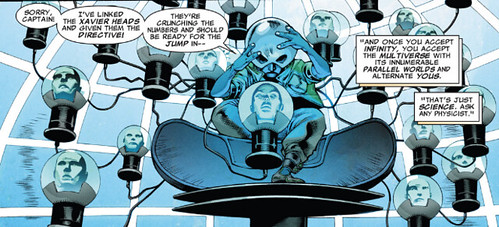
X-Treme X-Men delivers the essence of all that in a "steampunk alternate reality heroes joining forces to stop evil Charles Xaviers throughout the multiverse" package.  It's fun. It's functionally one of the most fun comic books being released in stores today, and for some reason simultaneously the most "out of the loop" in the entire company's universe.  X-Treme X-Men is like that cool cousin you only see at family reunions that has a crazy mother (your aunt, Astonishing X-men), but they used to be really geeky and stupid (Claremont's original X-Treme X-Men).  Now they've got a special oomph to them, though. They'd be a black sheep if your family even cared enough to notice them. 

X-Treme X-Men isn't a guilty pleasure, that's insulting. It's an anomaly, a set-up for early cancellation (think Firefly), by virtue of how quirky and good it is. But each issue is packed with snappy and interesting story, the art always somehow perfectly fits the quirky appeal of the story, and it flows well.  Overall, a real treat. Greg Pak deserves some Offbeat Title of the Year award, truth be told, and in this issue Stephen Segovia's jagged style moves like an angel with dirty wings.


8/10


Admit it. You've always secretly wanted to set an elephant on fire with Ben Franklin's ghost.


DEADPOOL #2: "WE FOUGHT A ZOO"
Cover Artist: Geof Darrow
Writers: Brian Posehn, Gerry Duggan
Penciler: Tony Moore
Colourist: Val Staples
Letterer: Joe Sabino
Editor: Jordan D. White

There are two reasons you're buying this comic, really. One, you know who Brian Posehn is, or you were at the comic book shop and you noticed Geoff Darrow's talented muckety muck all over the cover. 

You're not buying this comic because you love Deadpool, so don't pretend otherwise.  Deadpool's readers, myself among them, have been jerked around by this schizophrenic suicidal burn victim merc with a mouth for well over a year in the series before the Marvel NOW! revamp/rerun.  It's time for change, to borrow a line from the President of the United whatsit. 

Brian Posehn loves comics, but the biggest worry one has about a comedian writing a comic book is (oddly) that sometimes that just doesn't work.  We saw Kevin Smith flounder and flub Green Arrow and Daredevil (they called those "a tad talky" back in the day), and we've seen Gilbert Godfrey screw up that time he wrote an issue of The Punisher (lie), but almost immediately in this arc of the series we are introduced to all the elements necessary to expect a good run out of this comic, plus a sassy fat black lady that works for SHIELD (who enlists Deadpool in a "hurry up and get to the hi jinks" heated moment to stop resurrected dead American history figures).

The real test and payoff for this series is still a few issues away, but for now, the quips are fresh, the plot moves along at a steady pace, and Tony Moore's art honestly exudes how much fun he's having with it. When everybody stops laughing for a moment to catch their breath, we'll see if the stitch in our side is from all the laughs or inoperable lung cancer. 


8.5/10


There are currently 9,876 dimensions overlapping with Marvel 616. Next stop? Jersey City. It always ends up like this.


CAPTAIN AMERICA #1: "Castaway in Dimension Z"
Artist: John Romita Jr.
Writer: Rick Remender

We start this issue out with a flashback to a young Steven Rogers witnessing his father beating his mother, who not only stands her ground but teaches the future Captain America a lesson he'll carry deep into the future.  This gives Rick Remender's skills as a master of efficiency in scene dynamics a chance to shine. It also gives John Romita Jr. a chance to draw a bruised-up puffy face, his wheelhouse. 

In all seriousness, this issue of Captain America proves Rick Remender has the stones to run with the big dogs, as if there was ever any real doubt.  He goes through the checklist of perfect set-ups to establish character while paying homage to the arcs immediately preceding this one. Sharon Jones and Captain America's relationship, taken out and hung up on the wall for everyone to mull over. Zola and Dimension Z, hearkening to the first shows of promise Remender provided in the old days of Fear Agent.  

All the elements are present and everything is accounted for. John Romita Jr. is practically a seal of approval for writers at Marvel, at this point. He's familiar enough with the histrionics of the medium to convey everything more efficiently than he once did, and perhaps Rick Remender pushes that a bit with the script.  

In all honesty, this reviewer has not bought a Captain America comic book since 1995, when Mark Waid and Ron Garney involved themselves in much the same tones as can be seen here, in the old star-spangled super soldier.  For Remender and Romita, there will be an exception made, for however long it takes.


9.5/10


Would you attend a Power Point presentation put on by Bruce Banner? If the projector breaks we're screwed.


INDESTRUCTIBLE HULK #1
Artist: Leinil Yu
Writer: Mark Waid

Speaking of Mark Waid, bless his soul for taking on this particular project, after the various Hulk fracases of previous years inevitably sizzled back into status quo territory (as they always do, no matter how many different colored Hulks are actually produced, how many edges to Banner's psyche are explored, whatever)...

The difficulty, of course, comes with the fact that besides being a force of nature in purple pants when he goes green, Banner is a scientist, and he is overshadowed by Tony Stark and Reed Richards, and heck, even Peter Parker's got a job at Horizon Labs these days.  Waid pulls this to the forefront almost immediately, and then moves in with that SHIELD edge, now involving the inevitable Maria Hill interview.

After years of working on the series Irredeemable (and seeing it all the way to its natural and satisfactory conclusion) it's good to see Waid returning to the mainstream and one-upping any misconceptions about his status as Silver Age Standard.  With Leinil Yu as ever giving us cinematic expression with each panel, the major thrust of the new Indestructible Hulk is rather straightforward, but opens up to great realms of potential.  

If everyone involved wasn't already vetted, this reviewer would be concerned about the status quo creeping back in, or worse, the botched attempt at revamping the status quo, then the mangled attempt at un-botching the revamp, then throwing the whole thing out the window and trying to multiply to solve the problem, then trying to divide it, subtract it, and add it again.  I have just summed up nearly a decade of the various Hulk series up to this point. If anyone is capable of taking down that mess and putting it back to work right, dividing by zero, practically squaring the circle, it's Mark Waid. Godspeed, I say.


8/10


Friday, September 28, 2012

Reviews for Recent Comic Book Publications


Mainstream comic books in their present condition are such that the amount of capital invested to seed the future cineplex blockbusters is reflected through examples of the medium's true potential, as expressed in successes and even in the failures of its most dismal dregs.  As well adjusted members of American society slough off the birthing cowl of high school, so too must comic books deal with their history as a medium geared and stunted for decades towards children and grown-up children.  Superheroes are as integral to comic books as a medium as the journey of the hero is integral to most ancient and modern mythologies.  How well they are dealt with matters a great deal to the industry. 

It is the intent here to draw from the entrenched dichotomy of the supposed mainstream, the "House DC" and the "House Marvel" if you will, and analyze the weight and worth of their good and bad and meh recent releases, individually or in the context of story.  In fact, scores for each issue are weighted towards story, with exceptional art tipping the scales towards bonus points unless dreadful. Assessments draw from the history of the standard for each title, within and without the medium's standardized history.  Attributions for each review are added on a title by title basis.  


I, VAMPIRE #0
Written by: 
Joshua Hale Fialkov
Art by: 
Andrea Sorrentino
Cover by: 
Clayton Crain


We all know that a "DC Vampire" book to fill in the gaps near where a proper Vertigo title (American Vampire) germinates was somewhat inevitable, given the nature of the social biosphere that lets pap like Twilight create a buzz among young fools.  I, Vampire emerged in the post-Flashpoint foam of the New 52 as a stand-alone anomaly, meeting at odd angles with Justice League Dark in the "fantastic and magic" corner of the DC Comics New 52 color-wheel.  It's done a serviceable job to its readers and seems to take the popular Faustian trope for its main character, Andrew Bennett.     

The art for this particular issue sells the story in panels seething modernist influences of the medium and accenting them with a tinge, a pinch, a mere touch of Gothic sensibilities.  We get the origin story for Bennet, his connection and encounter with Cain, the first vampire.  The pacing is spectacular, the multi-page unfoldings by Andrea Sorrentino worth careful examination and appreciation.  In the dustbins of comic books, this title shines like a blood-red diamond. A fabulous combination of elements and delivers what it promises, specifically vampires, in a fresh, slick, well-executed package.

9/10


THE AMAZING SPIDER-MAN #694
Writer: 
Dan Slott
Penciller: 
Humberto Ramos


Throughout Spidey's career, he has been crushed under tremendous weights multiple times, both literal and situation-based.  I can recall the hologram foil issue of Amazing Spider-Man #365 where Spider-Man fought the Lizard in one of their many sewer-based conflicts, brick-debris and a train from Penn Station nearly crushed him. In true-to-character fashion, he thinks of all those relying on him, and finds the strength to Hulk out in his own fashion and free himself. 329 issues and several crushings later, he does something he's never done before. He acts as landing gear for a plane with Aunt May and Aunt May's pilot boyfriend on it, as well as many other civilians, J. Jonah Jameson's family members, and a cute puppy in the cargo hold.

Why?  Well, a few issues back with his gig at Horizon Labs, Peter Parker accidentally gave an irresponsible iPhone twittering jackass punk kid superpowers. The kid named himself Alpha and, in this issue, smacks around a near-cosmic villain like a tiger pwning a puppy.  In the process, though, he nearly kills a goodly sum of civilians, hence the Spider-landing-gear.  With each issue since the Spider Island scenario, Amazing Spider-Man has proven that it can pack in fresher scenarios of interest into what should be a rather tired enterprise of recycled plot.  There are still surprises and a marked gradation of potential for Spidey and Parker now, less restricted by the limitations of his origins. As super-genius and masked vigilante carrying cards to both the Avengers and the Future Foundation, Spider-Man has settled into "middle age" rather comfortably. The art and writing hit where they fit, and this issue is a relevant example of that.    

9/10


BATMAN INCORPORATED #0
Written by: 
Grant Morrison
Chris Burnham
Art by: 
Chris Burnham
Cover by: 
Chris Burnham
Variant Cover by: 
Aaron Kuder
Chris Burnham


It has not happened yet, but it will someday. A character is designed for a comic book that will be the synthesis of Batman without the bat, that takes a stance towards corporate accountability in a fashion where the scum of a certain 1% are taken to task for their malevolence.  Until then, we have Batman Incorporated.  Grant Morrison extends into his personal mythos of the balance between Bruce Wayne's money and Batman's dogged determination.  Batman as a global icon to be established with certain individuals throughout the globe is part of the nostalgia that is built into Grant Morrison's style and approach with DC Universe characters.  Behind all the merely clever bits he hearkens to the same thing all successful comic book writers do: he finds where he fell in love with comics and writes that. 

 The age of Morrison when he first touched a comic book was an era where a league of Batman-inspired international heroes came together to fight the injustices close and far from home.  It was a time of goody LSD-exploded rainbow Batmen and artificially sweetened boy wonders.  An extension of his well-done Black Glove storyline, Morrison's Batman Inc. #0 is a backstory for all the heroes of Africa, Russia, Japan, England, and Australia, but if this were to extend further could we find one in India, or for that matter Pakistan?  There is the promise of riches to come for DC if they continue to allow Morrison reign over their dreamscape archetypes, with the art possessing a dynamic shift from still to kinetic with every page, fitting every scene.   

9/10


FF #22
Writer: 
Jonathan Hickman
Penciller (cover): 
Ryan Stegman
Artist: 
Nick Dragotta


We have already established that Jonathan Hickman is a Comic Book God by some rights, and his ability to make a second ongoing title for the Fantastic Four, a long-troublesome and sometimes near-dead enterprise, is testament to his strengths.  His weaknesses come about in the noticeable contrivance of "wrapping up dangling plot-threads".  At times entire issues simply lack the weight of driving action required for the comic book medium, but they serve a sound architecture of plot overall, and at his worst Hickman's dialogue is too choppy or verbose, but it never seems hackneyed or dumb.  With FF #22, in the fallout of major cosmic storylines preceding it, the Fantastic Four (with Spidey! Five! Fantastic Five!) confront the self-styled science messiah The Wizard on an AIM island compound.  Bentley, a clone of The Wizard, has been raised in the FF family for some time now, the "inherently evil" wise-cracker kid akin to DC's Damian Wayne without ninja assassin training.  As always, Hickman delivers and the art is crisp perfect flow.  With Hickman's recently announced departure from Fantastic Four, it'll be interesting to see what direction FF, very much his brain-child, will head. Nick Dragotta's artwork is a perfect compliment to this series, with comfortably sparse scenery setting apt tones and characters possessing solid emotion to their expressions.

9/10


THE FURY OF FIRESTORM: THE NUCLEAR MEN #0
Written by: 
Joe Harris
Art by: 
Yildiray Cinar
Marlo Alquiza
Cover by: 
Yildiray Cinar
Marlo Alquiza


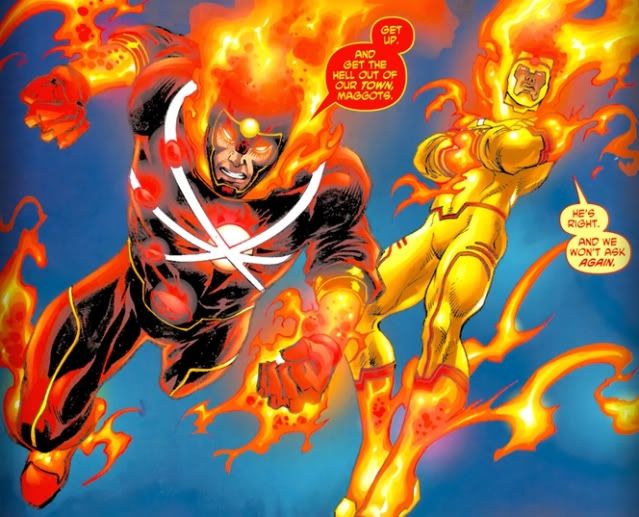
Perhaps someday Firestorm will be more than a simple superhero slugfest book.  Mind you, that was the limitation imposed on it by virtue of the New 52, where Blackest Night seemingly never happened, nor did Firestorm's entire history. The Fury of Firestorm series has read up to this issue #0 as "the superhuman weapon" motif gone weird, the Firestorm Protocols.  Captain Atom deals with the themes of the scope of his matter-manipulation powers, whereas Firestorm just apparently blows stuff up.  Firestorms, plural. Sorry.  

Major problems for this series include but are not limited to the flat characters, the seemingly pointless story arcs interrupted by seemingly pointless shock value explosions, often set at public landmarks and/or sporting events.  It may be that the series is geared towards action junkies that aren't looking for finesse or plot, but rudimentary structures set to give the flat randomly-motivated characters room to explain the things they're seeing as said things are seen, or spout cliche threats against people dressed just like them. The Fury of Firestorm: The Nuclear Man is garbled nonsense at its worst moments and regurgitated fight scenes at its best. The profundities and potential of the characters understanding their powers or having something more to them than simple reaction scenarios is never really explored for more than a moment. If the series is to survive, it needs to carry more emotional weight, or at least pretend it can. 

5/10


SPACE PUNISHER #3
Writer: 
Frank Tieri
Penciller: 
Mark Texeira


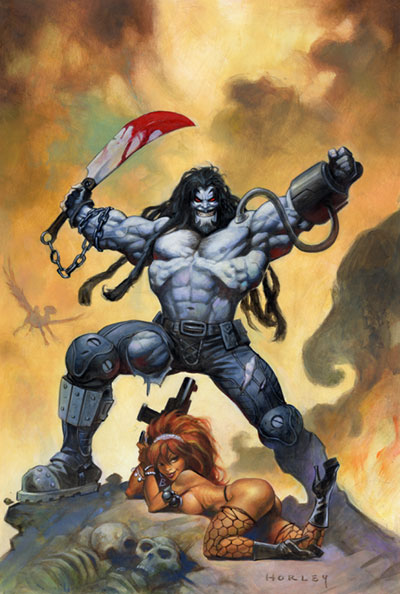
There's silly and then there's silly that knows how silly it is. On the heels of Deadpool Kills the Marvel Universe limited series comes a type akin in its major meta-style kookiness. Space Punisher, which is exactly what it sounds like. It's the Punisher. In space. This is that bit every Marvel fan speculated on at least once, where Frank Castle, armed with only a robot and space age weaponry, goes cosmic kill-ride with a list of most of the cosmic names of the Marvel Universe, along with variations of villains to murder memorably as he goes.  If you like over-the-top action thrill rides, senseless violence, and tentacle clone armies of Hitlers, heroes and characters warped between humor of Lobo and the no-nonsense ultraviolence of Judge Dredd, this piece of Marvel weird come to life lies somewhere in between.  In this almost-hilarious enterprise of an issue, Frank Castle gets closer and closer to his answers, and the Watchers that killed his family are in his sights. There's no need to think too hard about this one. It's a limited series, and it's fully aware of itself. The art is at times too spare, but overall it's a piece that can be spotted for what it is. Fun and action.

7.5/10


SUPERMAN #0
Written by: 
Scott Lobdell
Art by: 
Kenneth Rocafort
Cover by: 
Kenneth Rocafort
Variant Cover by: 
Kenneth Rocafort


In some ways, the dilemma of the DC stock of characters is wholly understandable. They see the need for constant revisionist history of storylines and events to fit the long-term goal of loyal readership.  With Superman we have the most difficult task of all, stripping away his acheivements and accolades and toning him from the level of Supergod to perhaps demigod.  Gone is his lawful perfect attitude towards all things, staggeringly high intelligence, and ultra-refined understanding of his powers.  

The New 52's Superman has been described as near-socialist in his stance as a hero. He fights against not just tsunamis and alien invasions, but government corruption, media bias, terrorist attacks and alien invasions. And tsunamis.  He's been taken down a few notches, save interesting portions of Action Comics and blips on the miasma of Superman as a title itself, where the old ideal shines through.  With Superman #0 we see his father's story, that is, Jor-El, studying the potential reasons for Krypton's imminent demise, which thanks to ham-fisted plot-tinkering would appear to have been arranged by someone of great power and influence.  The art for this particular issue is breath-taking, so much so that the sparsity of Krypton's culture in favor of a chase sequence conspiracy seems tolerable.  The final page raises whole new questions, and we are left with a potential storyline involving time-travel to unravel the secret conspiracy of why Krypton died (as apparently it's not just because Despair suggested it to Rao in Sandman: Endless Nights) and how that affects Earth's possible demise.     

8.5/10   


ULTIMATE COMICS ULTIMATES # 16
Writer: 
Samuel Ryan Humphries
Penciller (cover): 
Michael Komarck
Artist: 
Billy Tan


The past year or so of the Ultimate Universe has seen dramatic changes and bold decisions, mostly in the wake of Ultimate Spider Man's death.  Ultimate Reed Richards pretty much decimated Europe, killed almost all the Asgardian gods, went to war with a superhuman Asian army, and annihilated Washington D.C. will an antimatter bomb.  Texas immediately secedes. Meanwhile an Evangelical Christian bigot has co-opted an entire army of Nimrod Class Sentinels and declared major portions of the southwest as a sovereign territory, as well as calling for death to all mutants.  Who it turns out are human-made. So. Steve Rogers retires out of shame and this is what happens? What would happen if perhaps he was simply sworn in as president of the United States and rebuilt the nation through force of arms?  Ultimate Comics Ultimate #16 answers this question and a few others.  It's commendable enough that each Ultimate series and its Earth variant have moved further from and closer to the Earth 616 (latter being the surprisingly refreshing and tastefully done Spider-Men).  They piqued interest in what might very well have been a dud enterprise based on the lightning in a bottle that was Mark Millar's first pass at these alternate reality Avengers, certainly paving the way for works and multi-billion dollar movies to come.  Since the gradual phasing out of Jonathan Hickman for Sam Humphries, the title's dialogue has suffered somewhat in quality, but vestigal plot-devices linger on, leading to what may wind down into nonsense but for now keeps pace with the build-up that brought us to this point.

8/10


AQUAMAN #0
Written by: 
Geoff Johns
Art by: 
Ivan Reis
Joe Prado
Cover by: 
Ivan Reis
Joe Prado
Variant Cover by: 
Ivan Reis


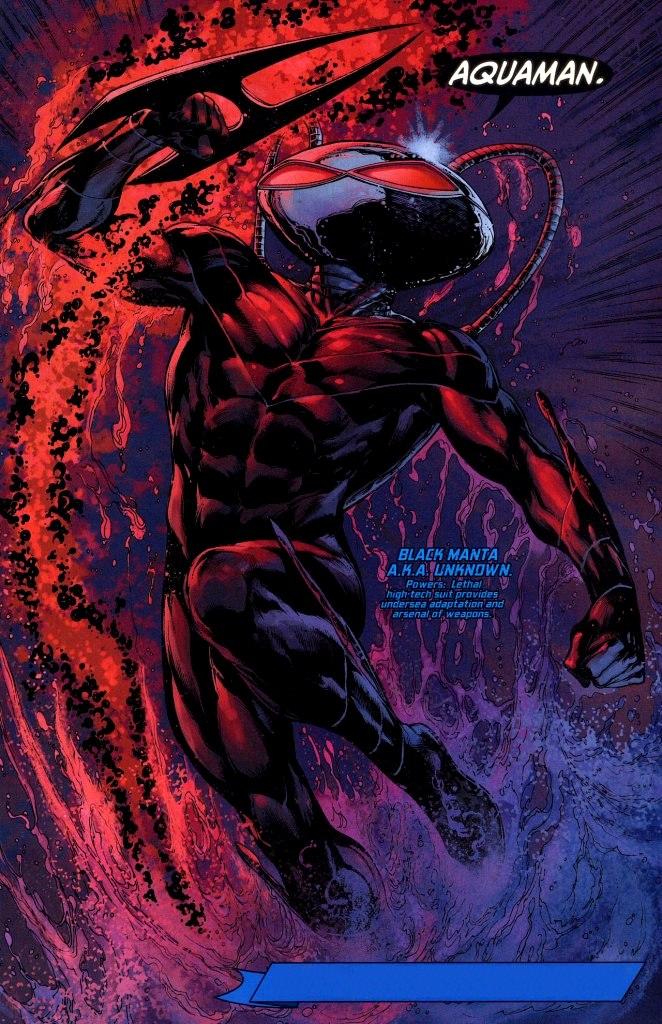
Admit it. Everyone thinks Aquaman is a joke.  The New 52 provides him a means to drop all the baggage of his history and start fresh.  So it is that with Aquaman #0 we see a story from his life where, prior to heroics, he's simply confused and angry about his questionable heritage and seeks out his first answers.  Under the sea.  In many ways the art of this series has been a major selling point, serving the story to such a great capacity that if it was a lesser artist would have killed the baby in its crib.  As things stand, Aquaman has come to a point where you can relearn his history without knowing the phases of "hand/not hand", "hook", "bionic hand", "sea god powers", "king/not king", "moody", "useless", "dead"... and reinforce his ongoing animosity with his half-brother Black Manta.  He's depicted too variably in what few other New 52 titles he's appeared in, but with this series, he's less out of his element, pun most certainly intended.  So long as they keep reminding people that the art sells the story in Aquaman and less the other way around, everything for this title should remain relatively kosher. Ha. Kosher. Get it? Alright.

8/10


X-TREME X-MEN #4
Writer: 
Greg Pak
Penciller (cover): 
Kalman Andrasofszky
Artist: 
Paco Diaz


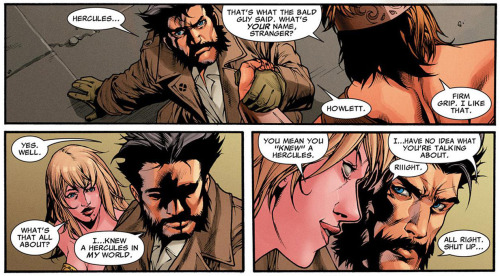
You'd be better off forgetting the Chris Claremont brain-child X-Treme X-Men that emerged from the sewers of Marvel around the same time as Grant Morrison's New X-Men.  The new title X-Treme X-Men follows a group of characters that first appeared in Astonishing X-Men, playing alt-reality foils to Lawful Neutral Cyclops in a reality where Charles Xavier is a bit of a dick-head. Then they reality hop, apparently along the lines of the little-loved but potentially fabulous Exiles series.  With X-Treme X-Men #4 the team, if in fact it can be called that, consists of a Charles Xavier head in a floating jar, James Howlett, Dazzler, and an alternate reality Nightcrawler (common since his death on Earth 616) and they team up to... well, it's hard to say. "Kill about a dozen evil Xaviers" fits, but it's an "episode to episode" scenario in many aspects, the true overarching goals unclear at a glance but hey, who cares?... Feels like the old series Exiles mixed with Sliders mixed with Quantum Leap, to an extent, and just like Exiles it's very mutant-heavy in all respects.  The art and the general "just go with it" attitude of the title overall save it from falling into the realm of being too snide or overly hokey.  If every two issues or so we get to see this reality-hopping crew have a random encounter or three, it should make for neat cover art at the very least.

8/10


RED LANTERNS #0
Written by: 
Peter Milligan
Art by: 
Ardian Syaf
Vicente Cifuentes
Cover by: 
Miguel A Sepulveda


Let's just say you don't want to be a jaywalker when the Manhunters decide to get feisty.  What has come as a pleasant surprise is that the title Red Lanterns has survived as long as it has.  It showed a strange sense of potential, twisted as that may at first seem.  Atrocitus, the first Red Lantern, provides explicit details of his motivations and origin with Red Lanterns #0.  Also, it turns out that he had relations with a demonic space squid, and learned the lessons of the Five Inversions, using their bodies to craft the Red Lantern battery in the first place.  These and other details are filled in that should prove of interest to both new and old fans of the Green Lantern stables of stories.  Overall, this issue shows the complications of a character you might expect in a Lantern whose primary motivator and power source is rage. Though not inherently evil, but more inherently brutal, the red end of the spectrum seems motivated by injustices rendered by figures of authority, and with the recent and blatant abuses of power rendered by the so-called Guardians of the Universe, along with the removal of Hal Jordan and Sinestro from the board, war is almost certain.  They'll be calling it the Rise of the Third Army.  This issue plants seeds for that and more, and although rushed in some spots and wordy in others, sports a certain confidence overall, which leads to a stronger fan base in the long run.

7.5/10


WOLVERINE #313
Writer: 
Jeph Loeb
Penciller: 
Simone Bianchi


This whole mess sucks. I'll get to this review when I am done wolveretching. God. Such a terrible taste in my mouth.

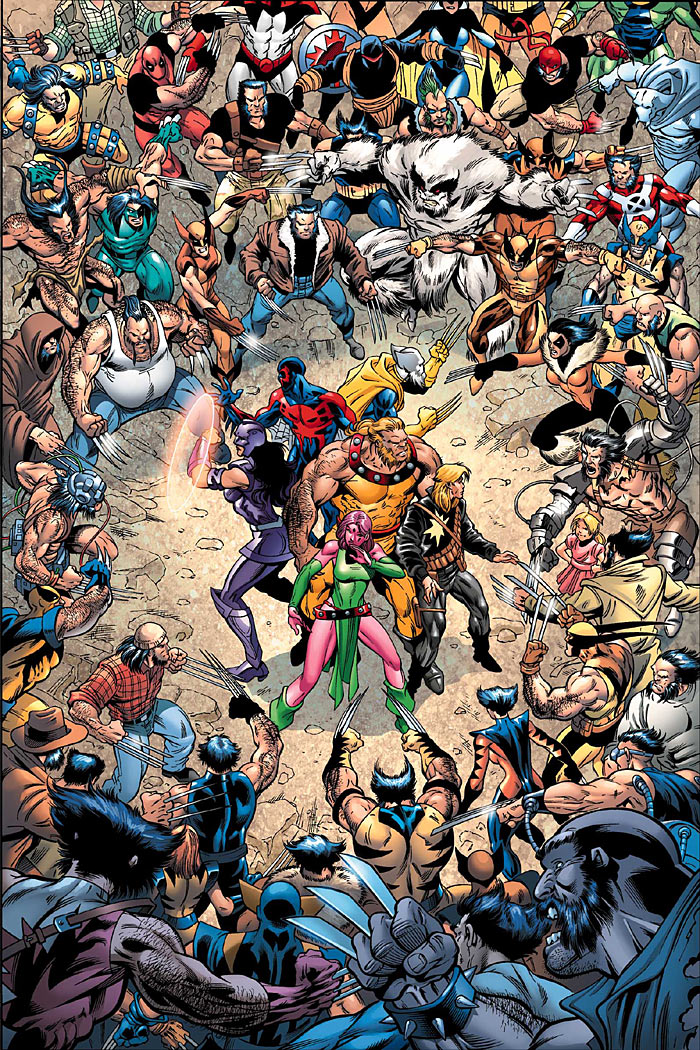
Really, how many times will Wolverine nearly kill Sabertooth?  Kids shelled out good money to see him decapitated once and for all, heck, there was a hardcover copy and everything. A clone killed Feral, is that what you're saying?  And this Romulus and Remus thing that we're led to believe was behind even what was behind the behind of Weapon X program?  

What's so effin' difficult about writing a Wolverine storyline? Sure, send him to hell, okay.  Let demons take over his body.  Then hem and haw over him dealing with the same tired pattern, maybe throw in a Gorilla detective for comedic relief, or gross everyone out with yet another hint at his mysterious past and shit, fine, you know what? Don't care.  Stopped caring. Wolverine should be dead from overexposure by now. He's impossible to kill by virtue of his popularity, okay, we get it, but you can write a story without it being about something fifty to four hundred other people have already done.  Mark Millar got it right, and that was ages ago.  Since his revelation of memory after M Day, we've had Wolverine run ragged joining the Avengers and becoming a headmaster of a new school and being featured in his usual six to ten guest star spots either subverting his classical image or tritely attempting to make it more shiny.

At the end of the day, this most recent plotline is to make us believe that Logan, James, whatever you want to call him may have volunteered for the Weapon X project, used to work for Romulus and Remus, and bladdah bladdah forget anything you knew before, let's change the ending to something besides a faked alien threat, yeah, let's make it, um, Dr. Manhattan bombing the world, sure, let's dumb down the whole thing like a Zach Snyder feature and end it with him kissing the hot immortal redhead or whatever, Christ, fine, do it.  Get Jeph Loeb to do this series forever, let him turn Wolverine into an actual wolverine. Yeah. Team him up with Liefeld and a team of cancer monkeys. It's over. I'm done with it. Wolverine's officially jumped the shark, folks. Nothing to see here.  

Art for the past few issues with this effrontery against all previous issues has been fantastic. That's it. That's all that's even remotely good about it.  Even then, to be honest, it just makes me nostalgic for old back issues of Heavy Metal. Let's strike these past three issues from the record. Bury them like E.T. the video game. 

4/10