Click!

Showing posts with label AvX. Show all posts

Wednesday, October 17, 2012

Final Assessment of Avengers vs. X-Men

Spoilers ahead.
"I love him. And I love you. I love all of you." : The words that killed Charles Xavier.

Over the past twelve months, we cut our teeth on the critical quagmire with Avengers vs. X-Men, the latest in a tried and true Marvel tradition of hyped mega-crossovers. AvX culminated just a short time ago in a number of transforming departures for the Marvel stable of stories, transitioning now into the much-ballyhooed Marvel NOW launch.  The players, for their parts, all played them with a certain aplomb.  Five Marvel Architects getting together to try to get at something big. The other fifteen to twenty-someodd people working on the project did their best.  

At the end of the day, though, all they've really and surely done is kill the only man in the Marvel Universe that truly believed in peaceful solutions as a means of resolving conflict. A character shunned for years, rendered impotent by unimaginative writing, and never given the proper hero treatment he deserved, under any editorial establishment.

They killed him and a skull-faced Nazi ripped out his brain and now the entire Marvel Bullpen will take turns defecating into the exposed cavity in is skull.  For YEARS.

This is the Final Assessment of Avengers vs. X-Men.

When you need to insert Yin Yang into your exposition, go big or go home, right?...


So maybe you already know, and possibly you didn't, that years and years ago the Scarlet Witch, insane reality warping redheaded mutant daughter of Magneto, whispered three words that wiped out the bulk of the mutant population on the planet.  Far from the measured response one might expect, the resulting mess of years where various teams and heroes vied for relevancy in a universe of unstable molecule costumes of all shades and sizes.  

The saga of Xavier had been expressed and tinkered with for years, but with the events of House of M and well beyond, the Marvel credo has been to remove him from the picture. His influence over Cyclops waning, time showed the establishment of Magneto's Asteroid M in the San Francisco Bay as the creation of mutant sanctuary Utopia.  This and other dramatic actions leaning towards militancy has often led fans of the series in its 90's heyday (Blue and Gold teams! The first ongoing cartoon!) or well before that to cry foul.  It stands to reason that Scott Summers receiving of the Phoenix Force was the culmination of his editorially-driven transformation from Lawful Good Lackey to Lawful Neutral Bastard to Chaotic Evil Douchebag (read: Dark Phoenixclops).   

This transformation has been intended to add weight to a myopic twit that many a fan has resented over the decades, and no doubt many a writer has wrestled with making interesting.  This transformation was gradual, then in sharp turns sudden.  This is the only means by which the militancy bred into a character like Cyclops, having a damaging beam of red blasting unbidden from his eyes did not make him a character of easy benevolence like Charles Xavier.  Scott Summers was tortured, mentally, wound so tight he could snap any minute, even without the tacked-on Mister Sinister plot.    

This may seem a digression, but it is set here to assess what could have possibly driven the character to his actions in the final stages of Avengers vs. X-Men, distorting and ultimately destroying a character decades in the making, even less capable of redemption that Speedball in Civil War. 

Anyone else getting a Cassandra Nova vibe off of Chuck in this scene? Also, note the setting sun. Symbolism, son.

When one of your lead heroes is a soldier with an American Flag incorporated into his costume design, it stands to reason that you'd be a tad militant in your procedures as a comic book company, at least in terms of story if not political allegiance.  Superhero slugfests are standard practice, a tried and true trope that makes itself relevant or irrlevant in terms of plot structure, but in the mainstream gains precedent more often than not.

The ultimate paradox of Charles Xavier has always been his Danger Room scenarios, his training of his pupils in the martial arts, which as it turns out was dastardly in more than one way (the Danger Room achieved sentience at one point, a secret Charles kept from everyone until Joss Whedon coaxed it out of him).  It set his students always at the edge, prepared for violence in a violent world.  

The militancy of the Marvel Universe as a whole is in fact best represented in the "Ultimate Universe", where a caricatured representation of George W. Bush welcomes a recently thawed Steve Rogers to the American Military of 2003. With his help the United States "wins hearts and minds" in Middle Eastern conflicts and occupations, eventually resulting in some blowback: the inevitable superhuman arms race.  

In the standard Marvel Universe of today all conspiracies steer clear of actually implicating any corporate or military structure  of being inherently questionable, merely villain-ridden. Roxxon? Just a bad CEO. The next one will be okay. A.I.M.? Hire them on as consultants but make them take off those helmets, and boom, they're no longer terrorists. S.H.I.E.L.D. as an entity curtailing human rights? Nah, just superhuman. We do have the occasional revelation, such as the one to Wolverine that Nitro was paid off by the CEO of Damage Control to explode next to a school full of children.  War is a constant in the Marvel 616 Universe.  Villain against hero, hero against hero, everyone has had a turn with everyone else.  Grant Morrison once planted an interesting seed of an idea to account for it. The mass sentient bacterial infection of superheroes and supervillains by the ancient archigenator Sublime, which forces the heroes and villains to such extremes of hyperbolic action(slugfests)...  When you see your fifteenth hero vs. hero a la Civil War scenario play out in the 616 Universe, you have to wonder if he wasn't on to something there.


Roughly 85% of the final scenes in Avengers vs. X-Men are people standing around .

So, once the idea of a peaceful mutant-driven Utopia was dashed with the impetuous attack by Namor on the kingdom of Wakanda (Black Panther's fictional and apparently coastal African country), and as the numbers of Phoenix Force recipients are dwindling down to two (since Spider-Man taunted brother Colossus and sister Magik into cancelling each other out), Emma Frost and Scott Summers are basking in fire and doubting one another's intentions.  

There can be only one, and all that mess.  

With these rumblings, all the loyal lackeys to the Phoenix Five (most New Mutants and associated mutant Utopian inhabitants outside of the students attending the Jean Grey School for Higher Learning) turn to Professor X, who has stood by the side of the Avengers since his impartial ending of a battle with a gesture.   

And of course, he guides them to Scott, to confront the Phoenix that has corrupted him utterly.

And Scott, like the petulant child that he is, kills Professor Xavier, the purveyor of peace and benefactor of all mutantdom, stone dead.  The Death of Charles Xavier is told in a whole page, silent as the grave.


Place your bets now. How long before it turns out he isn't actually dead? Generally ranges from 4 months to 10 years.


Then he goes Dark Phoenix, and we have the standard cliffhanger for issue #11.

To this any well-established reader will say "Whatever." 

You can rest assured, when a person in a Marvel Comic says "NOW AND FOREVER, I AM [Insert Cosmic Marvel Universe Force Here]!" that they will be summarily stripped of that power and all actions they take will be retroactively revoked in the following issue (sometimes two, tops).  This was displayed aggressively in Matt Fraction's exercise with generating Thor buzz (Fear Itself) and to some extent with Mark Millar's "Civil War" (which, to be fair, did actually alter the landscape of many titles for some time, towards and unquestioning loyalty to or churlish rebellion against an administration regulating super-heroics  but simultaneously set the tone for these expectations-raised hopes-dashed "hero vs. hero" storylines so frequent with yearly Marvel mega-crossovers).  To that end, the endless parades and fashions of resurrection are so entrenched in the system of Marvel that we can and should suspect that despite everything we have not seen the end of Charles Xavier, let alone the Phoenix.

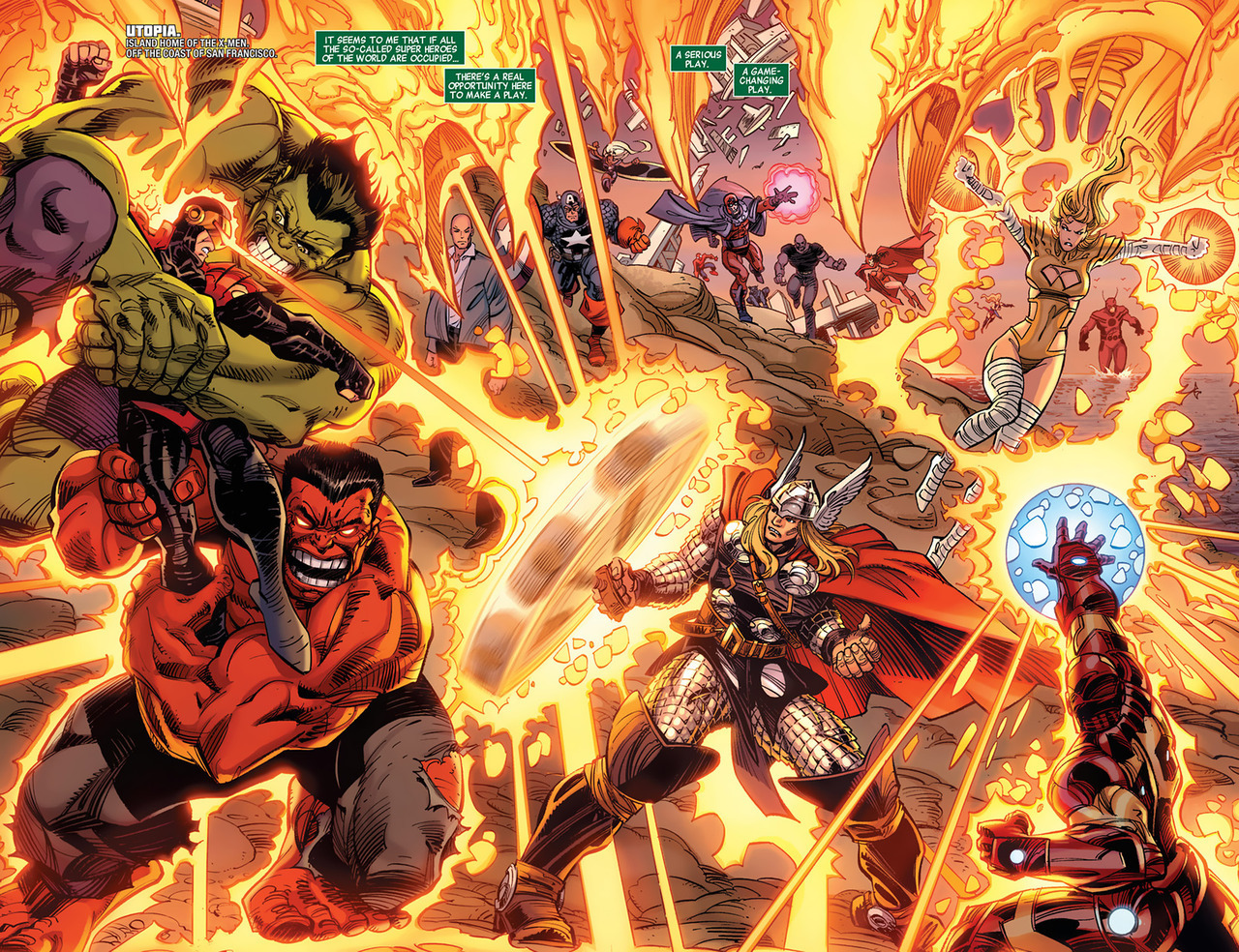
The battle rages among exploding volcanoes and fiery Phoenixstuff.  Somehow the heroes reach remote corners of the globe for one-panel shots of their attempts to stop the destruction.  And bladda-blidda-boo. Superhero slugfest. You know it's a big deal if Hulk's there.

Yes yes, very good wrath.


You might ask yourself why Charles Xavier had to die.  Outside of the spontaneous appeal of murdering a fairly well recognized character, it gives us something to do with what appears to be a frustratingly noble character who has had all manners of treatment from various writers to make him "interesting"... he was crippled by the Shadow King early on, then a mimic of him died when the mansion exploded the first time (and it was intended to keep him dead, even that early in the game, when the Marvel Universe experienced one of its first ret-cons)...and later, he faked his death, leaving Magneto as headmaster, getting the use of his legs back via his Space Empress girlfriend.  He returned to Earth after years in space, only to be crippled by the Shadow King once again.  He got a fancy bright yellow floating wheelchair for a while, then Stryfe, a clone of Cable, shot him with a techno-organic virus.  After Apocalypse healed him up, he rollerbladed with Jubilee for a night, then fell back into the wheelchair at the edge of battle stance.  Also notable is Professor X's encounter with Magneto on Asteroid M years later, when he mindwiped old Erik after he ripped the adamantium out Wolverine's skeleton, a fraction of Magneto's "evil essence" infected Charles, spawning the psionic identity Onslaught.  Onslaught takes control of Sentinels and attacks New York, and for a while Charles is in jail and his mutant students floundered.  Grant Morrison introduced the novelty of a mummudrai "sister" for Xavier, Cassandra Nova.  Later still, it was revealed he'd ignored the pleas of his sentient Danger Room for decades. He left the X-Men completely to their own devices shortly thereafter, but not before getting shot by time-displaced mutant Bishop, a red herring "death" that nonetheless drove him from main storylines outside of a brief appearance in Wolverine & the X-Men, and brings us to the Avengers vs. X-Men storyline, which outright murdered him. 

What if they said something else besides "No more Phoenix"? Like  "No more humans?" or "No more Fat Chicks?"

Of course once Hope, the long-predestined vessel for the Phoenix, finally receives its power, it's only after she has seen it corrupt five well-loved heroes.  She immediately undoes everything that Cyclophoenix started, what with the planet-wide devastation and all, then joins hands with Scarlet Witch, and in true Post M Day form, says three words that bring out the latent mutant genes of humans across the world, and kills or quells the Phoenix as she does so.

Which leaves us, of course, with the inevitable aftermath.  Cyclops, once he's heard that mutants are reborn as a race, falls right back into his stubborn douchebag shell.  To gain some idea of what will be happening to him in upcoming titles, just review the history of fun-loving Speedball of the New Warriors, who for the deaths of hundreds of suburbanites, mostly children, took to wearing a scourge-suit during his later runs through various penance-quests. 

Of course, instead the Marvel Universe Big Brains like Mister Fantastic might find a way to travel back in time, retrieve Marvel Girl and Cyclops from an earlier point in their timestream, shove their faces into their bleak future like a bad owner shoving his dog's face into a bowl of dog food, and further contort an already twisted and unruly knot of plots, sub-plots, irrelevant occurrences, and even more irrelevant deaths

Worst. Eulogy. Ever.

So now that we have finished with Avengers vs. X-Men the "Marvel Architects" are bringing us into the new era of power and glory, something they call Marvel Now! Truly, this cycle will never end, only sprout new heads like the mythical hydra, and then consume its own tail, or in this case, tale, like a fabled ouroborus. Scott McCloud's market model for the entire industry comes to mind.

Uncanny Avengers, written by Rick Remender and drawn by fan-favorite John Cassady, is provided for us as the most pertinent follow-up to the events of Avengers vs. X-Men.  The first issue features Chuck Xavier's funeral, with Wolverine providing a eulogy, a meeting between semi-estranged brothers Havok (a plaything of Peter David's since a few years back, toothless and subservient) and Cyclops (douchebag), the strident insistence of Captain America that he is not a jackbooted fascist, Iron Man and Ms. Marvel's search for Magneto, and a confrontation of the Scarlet Witch by Rogue at Xavier's crypt.  When shoddy animal-beasts with Remender Disposable Characters written all over them show up and make short order of the two, then dispatch with Xavier's corpse, you may think nothing of it.  

Then we have what may be the single most telling event of recent Marvel history.

What if it was in a big honkin' ice cream scoop?


As previously discussed in this blog, Rick Remender has a special talent in his approach to the Marvel Universe, and it is often a blood-thirsty corpse-strewn event.  When one sees the brain of Charles Xavier in the palm of the Red Skull at the end of Uncanny Avengers #1, the fanfare around the death of Captain America after Civil War and the death of Ultimate Spider-Man are not at all drowned out by the death of Professor X.  There was no proper announcement for this "end of an era", but rather fizzle of fanfare, a thudding drumbeat to apathy, a cricket chirping, fading into silence... that is what surrounds the death of Xavier, peace advocate who could see into all of our minds and understood that we could be better.

If Avengers vs. X-Men has provided any subtext at all with its bold attempt at retrofitting comic book mainstream dynamics (superhero slugfests), it is this: Evil wins. Good men fail.  Good virtuous men will have their brains scooped out by Nazis.

Fighting is the best answer to anything.  War is purifying. Death is an illusion.  Dreams are never realized. Utopia is impossible.

The past is irrelevant. The future is uncertain. The only thing which exists is an eternal now, and continuity be damned, there will be no voices of peace in that eternal now.

Ignorance is strength.  If you attempt to reach new heights, you will be corrupted by your own hubris.

Give up. There's no cosmic force ready to stop what's coming next. What is here Now.

The Marvel Universe Militarization is Now.


Saturday, July 7, 2012

All-New Uncanny Impressions of Avengers vs. X-Men.


As discussed in prior installments, the megacrossover world shaker Avengers vs. X-Men is still in full gear, with the arrival of the Phoenix (and its subsequent fracturing) literally remaking the dynamic of the world as a whole.  Cyclops, Emma Frost, Colossus, Magik and Namor each share a fraction of the Phoenix's infinite energy (call them the Phoenix Five), and rather than prove the Avengers right (that is, destroy the world), they issue a declaration of Pax Utopia. The entire world receives free energy, ample food, clean water, and the annihilation of weapons of mass destruction. All military conflicts come to a halt. Deserts are irrigated. Sentinels are annihilated.  Food is plentiful.  The status quo so firmly established as a matter of course in the Marvel Universe 616 is deviated from strongly, and ably, thanks in no small part to the squad of extremely talented writers collaborating on this particular blockbuster.   

The various tie-in titles do a fairly good service to not upsetting the dynamic of reality and accenting the storyline (unlike, say, the truncated battle sequence depicted in "brawl title" AvX between Captain America and Gambit).  We see Emma Frost come into opposition with Avengers Academy, Rachel Summers (formerly Phoenix in her own right) calling her loyalty to the new world order into question, and Rogue scuffling with Ms. Marvel, who sows the seeds of doubt before being tossed into a Limbo prison.  Magneto serves as a John the Baptist.  Hope Summers trains in a mystical cityspace with the masters of Iron Fist and takes lessons from Spider-Man to prepare for confronting the Phoenix once more.


This twist has taken the Marvel Universe in a new and interesting direction and polarized fans in a fashion that simple slugfests never could.  Do you believe that the Phoenix Five's intentions are as pure as they seem, and that true peace can be established in a world where garishly costumed superhumans shatter concrete with wrist flicks?  Do you agree with the Avengers that such drastic changes always come with a cost, a backlash is inevitable, and that the more these mutants embrace their new powers, the more distant they will become from their core codes of morality?

There is also the notable issue of the Scarlet Witch at hand as well.  Her role in House of M (remaking the entire world to be one where everyone gets their heart's desire in a Magneto-run "utopia") has apparently been redeemed since, well, since for some reason every single Avenger has forgotten how badly she upset them and how dangerous her powers are, and oh yeah, she dismissed an entire race of beings with a fragment of a sentence.  Perhaps it's because she slept with Hawkeye that she gets a free pass.  It could also be that she alone seems capable of taking the Phoenix Five to task, and her connection to the Life Force (as established in Young Avengers: the Children's Crusade) is that common bond with the Phoenix that may prove interesting in the upcoming remaking of reality itself, not just the world, in a recently announced universal relaunch called Marvel: Now!


In more recent issues of the main title, we see the stark divide between the forces and note that the grey area (ha! as in, um, Jean) is vast on both sides.  In the most recent issue, Emma Frost nearly kills Hawkeye in a fit of anger (but don't worry, he's getting his own series soon, plus he'll completely forgive her once they have sex).  Internal strife among the Five will no doubt disassemble them (and Colossus is still the Juggernaut, in case you were curious). Charles Xavier's marginalization continues to expand and contract.  Captain America seems to have a born soldier's need for constant battle, his irrelevance in a world of perpetual peace perhaps an unspoken catalyst to his continually antagonizing the Phoenix Five.  Iron Fist's established ret-conned history with the Phoenix Force will grant him a +5 to his relevance.  Then again, maybe everything that's happened for the past ten-plus years in Marvel is about to be erased.  Or perhaps Hickman will simply set the Avengers out to "solve everything".

In terms of scripting duties, it's very interesting to note the emergent variations of style with each issue, and as every section of the story unfolds, the shift in artists seems fitting to the content.  Marvel, all foibles and wisecracks aside, is clearly bringing their A game.  Regardless of the final outcome, readers that have cared for and enjoyed each of the titular teams involved in this conflict are in capable hands.

What comes next, however, remains to be seen.  After years of established wetworks, continuity and character building, a relaunch (restart? reboot? revamp? remake?) of the Marvel Universe titles (Marvel NOW! NOW! NOW!) may cause fans to cry foul, or even worse, call "mimic", since as most comic readers are well aware, about a year ago the DC Universe erased its elaborately decorated chalkboard and started fresh (but in some spots shaky) with The New 52.

Regardless of outcome, the story continues to be intriguing and this reviewer, for one, will continue to buy it, if only to see where the trail leads.  If the end result proves ridiculous, then the purifying flame of my caustic wit will burn it away.


Wednesday, June 13, 2012

New Impressions of Avengers vs. X-Men (Spoilers)


In previous installments of this series concerning the current globe-spanning mega-crossover epic of the Marvel Universe AVENGERS VS. X-MEN, currently in its fifth installment (not including the multiple main title tie-ins), we assessed the context, explored the basic structure of the plot and predicted (accurately) the progression of the storyline.  With the fourth issue, we have a twist on top of a twist.  Wolverine promised to take the "mutant messiah" Hope to the moon, and that he did (after a brief confrontation with a Shiar death squad in "Wolverine and the X-Men"), but not before contacting Captain America and the Avengers.  The issue ends with Thor being thrown into the midst of these heroes, forming a crater (running against the current continuity of New Avengers, which will no doubt catch up shortly)... and the Phoenix, after much build-up, has arrived.


Hope's mutant powers react, of course, and as has been the way with her since her introduction, we are treated to the old "I'm not ready for this!" effect.  In the course of events she actually manages to take out all the X-Men and the Avengers.  Terrified, she calls on Wolverine to kill her, again. Considering Wolvie has been slashing Captain America and Cyclops alike in the guts over the past few issues, he's more than happy to oblige.  At this point the stubbornness of Cyclops is bludgeoned over our head for the umpteenth time.    

The main issue that one might call forth as a critical issue with this series is the overabundance of talent.  With nearly a half-dozen contributors to the story and script (Jason AaronBrian Michael BendisEd BrubakerMatt Fraction, and Jonathan Hickman seem to be trading dialogue duty with each issue), each and every panel and event feels polished to the point of being over-refined.  John Romita Jr. does a solid job, as expected from such a diehard professional, managing to balance out the art duties of an epic storyline with the repetitiveness of an overextended premise.  He's moved beyond the blocky standards of his early work and the inks/color/computer assists do a fine job of complimenting him in this series.   


At the end of the day, Hope is what the story hinges on, and despite valiant attempts at texture, she's entirely too shallow a character to pull it off.  A powerhouse of potential (a point driven home again and again, in each and every appearance she has ever made), she's hardly had time to be addressed as having human frailties (a few moments in Generation Hope notwithstanding).  A heap of ideals and expectations have been passed off onto her, and there's a degree to which she is an inherently unlikable character.  There's the overblown manner in which she addresses events in this series, in the past tense, as if telling the story after the fact (making references to the dropping of the atomic bomb on page one, referring to herself as a victim, like so many others, of the Phoenix, on the last page).  She takes few actions, and events happen to her.  This is her weakness as a character, being presented for some reason as a strength.

But despite that, you might ask yourself, at what point does this much-anticipated series jump the proverbial shark?


When Tony Stark equips himself in a giant Iron Man costume and shoots the Phoenix with a heretofore unheard-of deterrent weapon, a "Phoenix Buster Suit" if you will... he damages it, fractures it, and its power, rather than being transferred into Hope, is split among the X-Men present on the moon (notably removing the trademark Juggernaut helmet present on Colossus up until this point in the series, perhaps purging the demon Cyttorak?).

Really, who saw that one coming?

At best, Avengers vs. X-Men is breaking ground on the "next major plot point" to be bandied about in editor-notes on mutant-related titles for the next two to five years, potentially dovetailing with something catastrophic and "ultra-relevant" in the next two to four months (if the incessant and ever darkening foreshadowing narration by Hope is any indication).  At its greatest aspiration, this marks a storyline contending with The Dark Phoenix Saga or Civil War in terms of impact (until ret-conned by editors in an obscure limited series if or when fanboy outcry reaches its most strident peak and someone decides they never liked Emma Frost in the first place).  

Or, at worst, this series will play itself out like nearly all "hero vs. hero" slugfests up to and potentially including this point... an exercise in pulling punches.  You have to wonder if there is any writer in the Marvel stables considering the What-If issues that each step of the series could spawn, or the parallels of these "hyper-mutants" that a select group of X-Men become in issue five.  At its lowest point, it could be viewed as just another money-maker, with no real lasting impact on the characters involved.  The final verdict on that, of course, remains to be seen, but despite all the "major events" occurring, it's a possibility.

With the most recent issue of Avengers vs. X-Men, we have a crux, a tipping point, in which the final heft of the series will shortly be determined.  With the PhoeniX-Men "preparing" Hope the petulant brat messiah for her upcoming important/irrelevant role in mutantkind's final fate, it's in the hands of Marvel's finest writers to steer the ship of the series out of troubled waters and into more familiar channels, or venture into new unexplored islands of potential. A world-wide mutant "utopia"? A replay of the Civil War trope "heroes putting heroes in jail"?  It stands to reason that whatever comes next will prove profitable for the House of Ideas, regardless of its actual effect on the Status Quo.  Rock the boat even a little and you'll draw attention.

So, in short, the talent combining for this event is staggering.  Is it too big to fail?  Are the creator's ideas bigger than the reader's stomachs?  Fan reaction has been buzzing throughout message boards, but we'll have our final answer soon enough.

Charles Xavier's stepping out of the shadows, and clearing his throat. 

Wednesday, May 16, 2012

X-Men Second Coming: or, The Meta that ate Itself

If you are going to discuss the X-Men war across America known as Second Coming, you will have to get Nightcrawler's death out of the way first.

Let's do it as glossy as possible. Great, thanks.


There, was that so bad?

In all seriousness, the first arc of the storyline focused on the supreme Nimrod-like Bastion and his gang of resurrected racists taking out the X-Men's resident teleporters.  Ariel, the Vanisher, and Illyana Rasputin fell before a jet missile, a hail of bullets, and an arcane banishment payload, respectively.  All of this due to the arrival of Hope from her junkyard future in the 31st century with Cable, of Liefeld ages gone past.

Bastion, being from the future, has insider information on Hope.  He knows what the end of Avengers vs. X-Men will be. He's also a mutant-hating robot with a mission to exterminate the mutant race.  He wants her dead because the x-gene will activate more if she is left alive.  The Gold Celestial's proximity to San Francisco is no coincidence.  Kurt teleports her there after Bastion puts his hand through him.

Not a dry eye in the house there, guys.


As we can see, the cost of messianic fervor is paid by the moral conscience.  Nightcrawler represented, in many respects, the team's heart. He held a relgio-spiritual status among a band of blatant outcasts. He internalized the weight and responsibility of a Catholic sense of morality.  Directly prior to his death he discovered that Cyclops had sanctioned a mutant hit-squad led by Wolverine, good old X-Force. Nightcrawler of course took issue with the blatant killing of innocent or helpless enemies, no matter how bad.  In the course of Second Coming, morals are continually compromised, and murder happens at an alarming rate.  A human supremacist begging Wolverine for his life is gutted.  X-23 pops a helpless man in the brain with her claws during interrogation.  Warlock is convinced by Doug Ramsey to steal the lifeglow of Cameron Hodge and his smiley face followers.  Archangel, having become dominant for Warren Worthington III, cuts people to pieces and never even changes expression.  

When this was first drawn on a bar napkin, it seemed cool. In 1986.


When I see all this mutant carnage I call to mind the old Chris Claremont era, where in one instance Wolverine gutted and nearly killed a confused Rachel Summers (Phoenix by proxy from parallel timeline) for wanting to murder mutant witch Selene for enslaving her.  Claremont wrote in an odd moral code for a man whose power is constant regeneration and unbreakable claws.  The X-Men of that era would often say "X-Men don't kill."  Once the ingratiating  and peaceful influence of Charles Xavier gave way, in recent years, to the crashpad of Magneto, that motto seems to have long gone by the wayside.  Since Scarlet Witch's heavy trip, Mutants are a desperate aberrant in the Marvel Universe once more, nowhere near the scope of evolutionary step predicted in Grant Morrison's Planet X.  

Foreshadowing, anyone? With red eyes, grr. We're tough, our eyes are all red. Grr, moral dubiety.


Throughout the X-Men's long standing career nigh coming on about forty some odd years now, they have undergone dramatic shifts of cast and presence of mind within the framework of what constitutes a story. When mutants bottomed out after the last reality warping schizophrenic lost their grip (felt like the subtle influence of Sublime behind the scenes), and relocated from the bombed-out Xavier estate and come correct with Magneto on Asteroid M turned mutant sanctuary Utopia. 

Seemed like so much recycling of old fears and worries for the same characters that once found themselves faced with a nightmarish Holocaust-level scenario.

For all the brightly colored spandex of the past we can see hints of mixing and matching old Claremont storylines in the midst of all this.  New Mutants meets Days of Future Past meets the myriad Sentinel hunts, the Master Mold of a dystopian tomorrow, personified in a brick wall plastered with those inefficient posters of dead mutants, disturbingly current in their appearances.  Which brings us to the idea of this whole storyline being metaClaremont.

The precise moment that this trope jumped the shark.


The Claremont era of X-Men has been the most fertile grounds for future storylines for decades now. To revisit that waterhole again and again compounds itself, as stories continue emerging from stories and characters develop and react throughout.  Once you've committed yourself to sending up or rooting out Claremont's old pastures, you're muddy with backstory.
Recent issues of the X-titles, leading up to and in fact catching its stride in Avengers vs. X-Men, have worked towards a new set of myths to create templates of arcs off of.  Easy examples come from the Morrison, Whedon, or even the fairly recent Fraction era, where new villains and challenges emerged, blended, and were ably handled.

In Second Coming, the other end of Messiah Complex, the refinement of new "big deal" Hope continues, as it will soon be coming to a head in current continuity, and we should take a moment to acknowledge other odd-run revamps being called forth in the war (everyone says the entire series run that it's a war), Professor X's schizophrenic son of an Israeli mother, Legion.  Legion did, some time back, spawn the Age of Apocalypse universe by accidentally killing his father when he went back in time to kill Magneto.  His imprisonment/rehabilitation in Utopia was played out in another alternate reality he spawned, The Age of X.  So when Professor X calls upon him to unleash his multiple personalities to defend San Francisco, it's an interesting throwback to remind Marvel readers that all powerful characters have ultrapowerful offspring (Scarlet Witch, Jamie Braddock, and Franklin Richards come to mind).      

Actually, pretty cool set up in your head. But that hair...


2011 was the year that all of 2012 X-continuuty and the Avengers vs. X-Men was laid out, with the return of Hope, sent to the 31st century with Cable, son of Cyclops and a clone of Jean Grey, who is dead but died at least three times, rose as a Phoenix and was killed again by a clone of Magneto run amok on mutant power enhancing drugs. But I digress. Hope is blatantly the forthcoming Phoenix by the end of this series, but I am going to appraise its overall structure and hope to make sense of the plot, which expects the reader to have kept reasonable pace with the story and all of Chris Claremont's run including the New Mutants, for the past ten to thirty years. Nimrods and Bastions and recycled plots via recycled characters via constant Resurrection countered by constant death. Officially, Professor X has also died at least three times, too.

The X-Men are the most ridiculously injured by and least affected by death in the Marvel Universe. The avatar of this odd trope is of course the nearly unkillable Wolverine. His ubiquitous nature in the Marvel Universe expresses this as well, as characters live, die, are ressurected by contrivance of plot, and Wolverine can outlive them all and fight the Hulk in the ashes of civilization.  In the Ultimate Universe, Logan, or James Howlett, actually, was mutant zero in the human creation of mutants through attempted weaponization of mutants via Weapon Plus, the outcropping of Captain America's super soldier program.

In any event, the plot plays itself out in various psychodramas that emerge from the team dynamic and whatever confrontation the team must face.  Second Coming, in all of its metaglory, is worth a reassessment after the final throws and lashes of Avengers vs. X-Men dies down.  In the meantime, see it as a (hopeful) last hurrah for direct sips of the Claremont pool, at least until other water sources, or better yet, a running river of fresh concepts can be located, perhaps even in as recent and well refined an example as Rick Remender's bizarrely perfect Dark Angel Saga.


And sometimes the foreshadowing is just like a mallet upside the head.