Click!

Wednesday, March 7, 2012

A few words

I could quote a series of intellectual elites that have seen the value of the sequential artform that has come to be known as comics, but the fact of the matter is, the biggest obstacle to the matter is also the solution. Superheroes.  With the recent DC initiative called We can be Heroes, the company is discussing providing aid to the ailing.


So what is a superhero?  Heroes arise from the humblest men.  Superheroics has been thoroughly dissassembled since Alan Moore's Watchmen. Is Nietzsche's overman what comes to mind, perhaps? The superhuman passes a moral tipping point at some point in every universe they manifest in, because they are no longer truly human.  Laws of physics sometimes don't apply to them, so how could rule of law? The matter of caste system immediately arises if the superhuman becomes a certain percentage of the population. This antagony arising from "You think you're better than me?" arguments arises on media and over the dinner table.  Buzzwords infiltrate conversation. Internet slang proliferates.  The future becomes the now, and tomorrow becomes today.  We design edifices of acronyms and false equivalencies, hoping that the next step will bring greater understanding.


But this is all tangential to the nature of comics the medium, infiltrating all media, potentially the freest artform in and of itself, and most of all the univerality that arises from comics.  Perhaps you'd be best served calling the subject bande dessinee, or drawn strips? Pull forth from the froth of those that came before, the Winsor McCays and Krazy Kat Ignatz genuises that designed and delineated our time in the first place.  The genius of the medium itself lends us to new innovations, always. Superheroes and comic books are complimentary because the comic book medium is the most superior and yet juvenile form of art in existence, the optimistic young go-getter with potential as-yet untapped.


In the end the best comic is one you can put on your shelves and be satisfied with.  But a book is merely bound sheets of paper.  Strips of glyphs. 

Saturday, February 18, 2012

On Quotes, Picasso, Warhol, Genius, & Country Matters


“Good Artists Borrow, Great Artists Steal”

“Immature Poets Borrow. Mature Poets Steal.”

I have had these two quotes knocking about in my head for a while, live-ins that have overstayed their welcome.  The first we attribute to Picasso, the latter to T.S. Eliot.  Stravinsky has his own variation.  It takes time to understand these statements, to get at their marrow, though they seem simple enough.
Art is a mystery to anyone outside of the maybe those twenty or so people claiming to have a cohesive grip on the Art World, whatever kaleidoscopic chimera it happens to be at this moment, whether it’s nostalgic/romantic, natural/contrived, passive/reactionary, or sublime/vacant.
The greatest joke in Picasso’s statement is that he very clearly wanted to be associated with the Artist as Genius archetype (and nobody but a few bitter unknowns in Postmodernism’s soup here, well after he’s been dead for decades, dare to argue against his embodying that). His definition of artist extended into the poetic and musical arts, whereas public education has, for America, at least, marginalized it into a hobby.  Humans need art, I cannot stress that enough. It’s food. Stored information on a sunbeam of thought, a record of a thought’s passing. The human story is so simple it seems complex, and the devil is as always in the details, but one should recall that a letter is only a symbol, a word only a character, a sentence only a section of canvas, a layer of gesso first, then a well-worn trope dollop of this color or that. Let the devil worry about the details. What style of painting would you consider this short essay?  Rococco purple prose?  Minimalist realism?  Abstract Expressionism underscored with Dadaist wit and Imagist sensibilities? 
Genius is misunderstood in our times as it has been in all times and sadly will be in most times to come.  
Dreamers are marginalized for the sake of fools and sociopaths that inerited their shameless mother’s verbiage and calculatingly mean father’s sense of entitlement. Often limited to associated patterns (imprints) set up by those that came before them, the populace as a whole struggles with the sheer stupidity of excess that is provided them by modern convenience. If you want a Q.E.D. on that, look out a window.
Picasso was one of the final geniuses of the Modern art world, and his kind no longer exists. Most burned out, shot themselves, or faded away like family postcards.  Sad but sweet.  

Warhol made it acceptable for the Artist to Not be a genius, and with his “factory” he fulfilled the promise that the Industrial Revolution & (following WW II) the Plastics Revolution made, effectively that nobody is special, but slightly varied wholly interchangeable components of a great and merciless machine that runs society for the sake of profit and prestige. But that’s cool, that can be worthwhile if the material excess is your game, as the New Archons start inculcating a whole new generation of artists with tacky kitsch advertising that owes its roots to everything that fateful Campbell’s Soup Can represents.

You can hardly blame Warhol for the resulting Revolution of Lowered Expectations. If it hadn’t been him, it would have been someone else. The same could be said of Hitler or Bush.  Shills are corrosive when they are in power. Reactions such as black presidents or stock market crashes occur when a corporate stooge instigates needless conflict in the name of a prophet whose name was been abused repeatedly since the Holy Roman Empire came into being.   

With the rise of new technologies and interfaces there are now numerous means of producing the Ultimate Cool.  The responsibility is staggering.  The collective imagination is such that certain areas in the shallower regions stagnate and compromise the entirety of the deeper, stiller regions.  

Those that access the ocean of Art World are usually open minded, and they react according to the parameters indoctrinated into them by their family and their friends and their social expectations, just like a closed minded person would, but often with a better sense of humor.  The voice of the closed minded are staggering but in truth very minimal in scope. They cannot rewrite a history based on light particles and keyboards.  The future will bring more shame to the closed minded, in a historical sense. 
The only cure for this malady I can prescribe may be the revival of an old archetype, that of Artist as Magician, though on the more exoteric levels of the Art World, one can easily see how information media is already pervasive enough that, even if at times somewhat ignorant, the common man cannot claim innocence to searching for that in his media.  Harry Potter and various other fantastic characters from books and movies inhabit an adult’s dreamtime as well as those of children.  

The cynical old man or the optimistic young one would perhaps come to blows on this issue, given proper inclination and circumstance, but how is it that a middle-aged man who has never so much as entered a museum in his life may, upon observing a post-Warhol piece, let’s say an enormous example of abstract expressionist painting, say something to the effect of “Hell, I could do that.”
This man doesn’t take into account that artist was able to create this or that work only at great personal expense, believing in this or that benefactor, conceding this or that ideal for the sake of a commission or a show.  The man that says “Hell, I could do that” hasn’t been shaken by art and thus does not understand art because he has better things, more practical things to think about.  This is one of the reasons why Dada died & Surrealism grew to the point that it saturated the worldwide thought-currents, impacting the following century of advertising, design and illustration overall.  

People are strange and stupid and mean, as the whole.  Hobbes is oft quoted as referring to human life as “nasty, brutish, and short”. People as a whole are not prone to enjoy ideals beyond their grasps, but rather, to become frustrated and even frightened by them. This is proven time and again throughout the Internet, an aggressively growing entity that a whole new generation of people have lived with for their entire lives.  In the years where the future seemed bleak, I call on the Artist to shake people awake. Don’t you understand? Don’t you remember?  The future is now. Today is quite obviously tomorrow.  It should but doesn’t go without saying that Art is forever bonded to humanity.  I cannot stress this enough.  The scope of its impact on  the collective imagination can be found in elemental traces one may identify within all the forms of media humans consume.  

Just as the consumption of high calorie sweet treats may rot the teeth, so it would seem that in many cases the consumer mindset, wholly abhorrent to most truly creative efforts due to its being a democratically stymied system, has rotted down to the nerve. Overstimulated, cold is too cold, lukewarm is perfect. 
The efforts of a handful of old men have led us on a limited run high-stakes rigged game up until this point, gamblers and salesmen, confidence men with a very deliberate brain-washing schemes, their method of approach unsustainable but seemingly irreplaceable due to the very powerful sedatives provided in our drinking water and by our doctors, but we have to bear in mind that though it is a terrible game, it’s the only game in town.  

Sedation has its advantages for profiteers. For instance, any number of unfulfillable delusions or worries concerning one’s station and purpose and debt can be washed away by the warm glow of cable television. You can tone down your dreams until they’re monochrome, lower your expectations to the point of dramatic refusal to participate at all, though even inaction has its consequences.
But I digress, wander into a briar patch, fall into a ditch. No.

In light of the Obama Hope Poster/Shepard Fairey incident (in which we should stress he told NPR he recouped expenses and used the rest to make more prints and donate them) and having read the commentary and criticism from various vitriolic pundits in the internet’s Peanut Gallery, I put forth a point that few Doctors of English will argue with, simply that Shakespeare did not write every line of his work.  All right? Can you guys please understand how that worked? He was a Master of Form and composition, true.  But he and most of his fellow playrights adapted and outright stole from one another.  Overall he was able to use his pilfered portions to tell the essence of Old myths and histories and address the time and place in which he lived.  Even in a time when the populace at large was illiterate and filthy (in our own times, voluntarily so), creativity did not stagnate. True, copyists are eternal as art itself, and we are regurgitating Shakespeare in awkward clips and have been for centuries, but we moved well beyond that, didn’t we?  Language evolved, like you do.  

Creativity is subjective, as are All Things.  One does not escape themselves.  An artist does not steal as a thief.  An artist captures the essence of something, Anything at all, and reflects it at an audience, participating as scientists in an experiment, waiting for a reaction to occur.  If one is dishonest in their artwork, it will either show or they will be uncovered as hacks, frauds, or worst of all completely unoriginal fools.  

If they’re able to mix equal parts charisma and courage, working the industry to their advantage, manage scheduling with the galleries, all the things you’d expect, then perhaps they’ll get a break from some kind-hearted patron or foundation, one of these few gifted people will stand out from people who have to hone their honesty to be noticed.   

Monday, February 13, 2012

Twitter has Exploded over Before Watchmen

Carefully examined by numerous industry professionals, the events after the announcement of DC producing a series of prequel comics based on Alan Moore and Dave Gibbons' Watchmen.


Some artists did not want to get the press that would hit them over this.  It's an intimidating project on several fronts. Back when Watchmen hit the scene, it acheived, loosely speaking, status as a type of Bible amongst geeks. A little later Neil Gaiman's The Sandman series filled the role of Shakespeare.  Remember Brave New World? Anyway.

The twitterverse has an intricate and closely monitored network of comic book industry professionals, and each one chimed in at some point on the issue. Fans emotional range was disgusted to apathetic to vaguely interested.  The joke of course being that they hand picked some very fine comic professionals to do the job, people who have credible resumes with various big project accomplishments. They are close to legends in some cases, like the riddle-monger of 100 Bullets fame, Brian Azzarello, and in other departments we have the accomplished Jae Lee and early era DC revisionist Darwyn Cooke.

All of this is of course par for the course when it comes to Alan Moore, a pioneer of the industry.


Moore ultimately seeks to advance comic books along the lines of literature, akin to but much more intense than his once-Miracleman-co-writer Neil Gaiman to infuse and mature comic books as a whole.  Moore seeks to advance the medium from his place of power in Northampton.  What he refers to as draconian contracts were in fact standard boiler plate for comics professionals for some time.

He was smart enough to build beautiful work after his runs with Mainstream professionals.

He's refined like a bottle of wine in a gentlemen's club cellar in London.


We'll just see how the whole thing turns out, eh?

Monday, January 30, 2012

Gaiman and McFarlane have reached a settlement in their decade-old Spawn copyright lawsuit

The Washington Post noted it here.

Todd McFarlane has gone on record as the most egotistical trash to emerge from the 1990's comic "boom"... rather a businessman more than a standard industry "grunt"...a glory hog and foolish. He got sued for using a Canadian hockey player's name in his Spawn series as a mafia stereotype. Todd McFarlane's a rich jerk.

Neil Gaiman exists as one of the most diverse and interesting writers to emerge from the more independently oriented version of that same industry "boom", and stands by the idea, rather unlike McFarlane, that writers and artists, regardless of ego, split down the middle any rights on any character created in the course of a given series, if said series is driven by the credo of "creator's rights". Neil Gaiman, also no doubt rich, is one of the nicest people working in the industry.

I am pleased that the matter is over, and hope that both parties know better than to ever deal with each other again.

Monday, January 23, 2012

One-line reviews of the New 52


Action Comics presents a new take on Superman, fighting corruption in a darker than usual fashion.


Animal Man draws on aspects of Swamp Thing, with fantastic art and a compelling storyline.


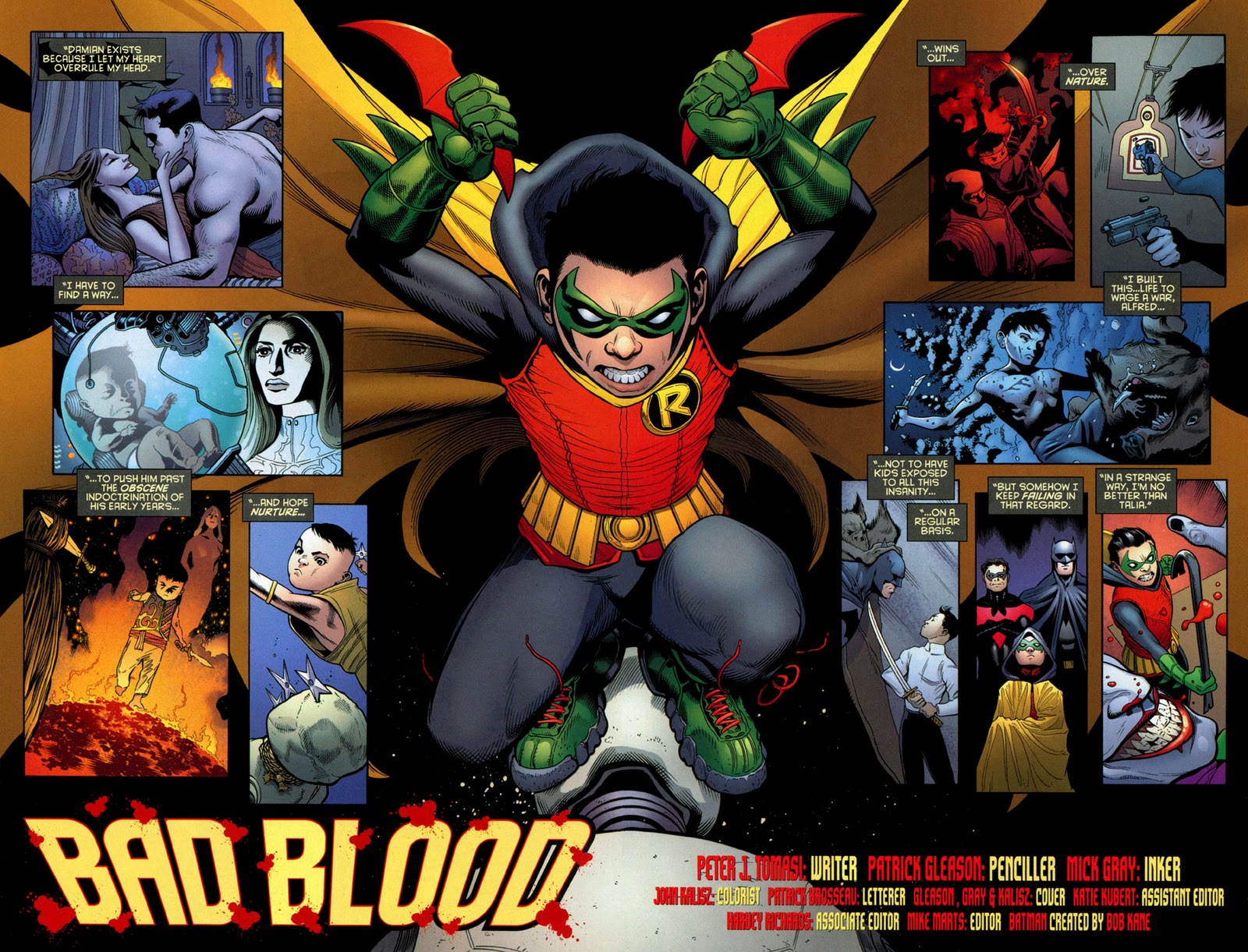
Batman and Robin provides us with an expansion of the troubled relationship between Batman and his newly introduced son Damian.


Demon Knights offers bloody violence in the Dark Ages, with an ensemble cast of characters.


Frankenstein, Agent of S.H.A.D.E. is that perfect fusion of superheroics and monsters you never knew you were missing.


Sinestro schools Hal Jordan in the new Green Lantern series.


DC seems determined to prove Aquaman is some sort of badass, as evidenced in the new JLA.


Justice League Dark calls together all the occult heroes to fight magical threats.


The  (soon to be cancelled) Mister Terrific series was a surprising pleasure to read.


Jack Hawksmoor, the King of Cities, consults with Paris, Metropolis and Gotham in the new Stormwatch series.


Villains fighting for redemption take the stage in the new Suicide Squad.


Swamp Thing may prove to be the most important series emerging in the New 52.


Saturday, December 31, 2011

The final Review written in 2011 (Grant Morrison's Flex Mentallo)


You've been participating in the world's first fully interactive quantum comic book, starring us! 

I discovered my secret magic hero word in a crossword puzzle my future self passed me. 

2012 is the year of many endings and the one beginning. 

Thank you for your participation. I love you. Look up!


Saturday, December 10, 2011

A Quick Review of Wolverine and the X Men Issues One and Two

Post Civil War, the Marvel Universe has been in the market to shake things up considerably every few months in terms of character development and overarching "big change for reals" story-lines.

Also, Wolverine is everywhere.  The Avengers, Uncanny X Force, X Men, his own title, multiple mini-series, a new animated cartoon, and every single cover of Wizard the Guide to Comics ever printed.

It should come as no surprise then that one of the new X-titles to make its way onstage claims a "bold new direction" for mutantkind as well as featuring our favorite vertically-challenged Canadian with an indestructible skeleton.


Wolverine and the X Men is, on its surface, the natural outcome of the Schism story-line that ran itself into the ground anticlimactically a scant few months ago. The plot for that so-called "Civil War of mutants" was pretty pat and shook the few remaining mutants of the world up, ever so slightly.  A new generation of the Hellfire Club (literally children) opened itself up to not simply exterminating mutants but making a tidy profit off the fears of mankind with the latest Sentinel tech, a tried but true X-trope (see: Claremont's Nimrod, Morrison's nano-Sentinels).  When the latest "suitcase" Sentinel is aimed at Utopia, the last bastion of mutant hope just off the Pacific coast, a rift between Wolverine and Cyclops emerges, interestingly enough with Cyclops taking the more militant position, and Wolverine seeking to follow Xavier's old premise of a "school for gifted youngsters".

After some unnecessarily proverbial team-divvying around a metaphorical campfire, the new title is born, rejuvenating the long-bombed-out Westchester County mansion.  Hope is a scarce thing in the Marvel Universe, on a best day.  Wolverine calls in Shadowcat, Beast, Iceman, Husk, Doop and others as teachers and administrators, and populates the school with all the easy-to-relate-to quirky mutant teens floating in editorial limbo since the school was last blown up.


The initial issue starts with the seemingly mundane task of passing an inspection by the state board of education.  Predictably, things go sour from the start.     Second one features a new leimotif common enough in Marvel these days: Pym particles mixed with bioengineering, replicating a power or a creature, Sauron and Wendigo, Frankensteins with Flame Throwers. Chris Bacchalo's art is the sort of complicated scenework that keeps fanboys rereading.   His expressions have always been down (evidences available for Logan and Oya) but he seems to have expanded his sense of motion since Generation X and his work in the Ultimate Universe.  The writing is fluid if predictable. Playing on obscure tropes like the Living Island Krakoa, keeping pace with new concepts such as Danger Room being a constant hardlight physical challenge, Professor X's dry humor regarding the eventual and seemingly inevitable destruction of the school.


All in all, the title shows great promise, despite Wolverine's overexposure at all times. Give the snail's pace of art and plot a few months, we may see something pan out in the Kid Omega subplot, followed by more problems with the Marvel Evil Youth League popping up all over.

Speaking of popping up everywhere, please note the Nightcrawler imps Bacchalo has a blast drawing, mentioned ever so casually by Hank McCoy, the supposed ace-in-the-hole candidate to charm the inspectors, shortly before hurling a coffee pot at them.

But more than that we can see the expansion of Bobby Drake, Iceman, via actions taking place in a recent issue of Uncanny X Force, another winning blend of good art and complex plot that takes no prisoners.  Iceman defeats the Frankenstein soldiers using a multiple man trick, expanding his consciousness into avatars.  Rachel Summers seems somewhat free of her usual clumsiness in a plot, Kitty Pride is a Jewish goddess, and Doop of the old X-Statix team would seem to be in charge of Registration.  There are throwbacks to the Sh'iar in the arrival of old egomaniac Gladiator himself with the introduction of his son and bodyguard...


The writer and artist have found a competent inker, a good crew of colorists, and a couple dozen interns to churn out this particular pile.  Their villain is children, seemingly growing more common in Marvel 616, with his own secret assassin squad in Uncanny X Force having murdered a reincarnated child form of Apocalypse which would inherit at accursed villain packed with Celestial technology.  But not really, because Fantomex, AKA Weapon XIII, misdirected everyone into thinking that was what happened, and has seen fit to keep En Sabah Nur in a laboratory protected by Weapon XV. Right. Meanwhile?

Wolverine's constant exposure pays off greater dividends, surely, or they wouldn't farm him out so much.  Touches for characters like poor Toad, old veteran of all the incarnations of the Brotherhood of Mutants... he's gone through so many changes over the decades, and if there is one thing in this new series relevant enough to note is that Toad's a janitor. Finally. At last.

And the toilets shoot fire.

Four and a half stars out of five for the inevitable delay of the book. Bacchalo takes forever to draw. But he's worth the wait.


A Quick Review of Alan Moore's League of Extraordinary Gentlemen

If you were to ask me my personal opinion of what Alan Moore's enduring legacy as a writer will prove to be, I'd be straightforward. In my opinion it's his run with League of Extraordinary Gentlemen.


The evidence speaks for itself.  The initial serial exploits of this League were compiled into two volumes, and after a long wait the Black Dossier arrived (with 3D glasses!).  Now, via Top Shelf, the latest (though hopefully not final) three part series runs through the amalgamated literati universe inhabited by the very fictions we have as a culture cultivated, to be adapted, patch-worked like a fine quilt, in the manner with which we have become accustomed to the Northampton magician.

League of Extraordinary Gentlemen by Alan Moore


The initial premise sounds like a promising pitch, collecting classic characters such as Captain Nemo, the Invisible Man, Dr. Jekyll and his Mr. Hyde, colonial hero Alan Quartermain, and set them under the direction of Wilhelma Murray (once the focus of Dracula's affections, if you recall), all in the service to late 19th century England, God save the queen, etc.  Coupled with the supremely talented Kevin O' Neil (of Judge Dredd fame), Moore sets these gaslamp understudies in adventures that at the outset play with conventions of literary heavyweights, icons that got to play opposite of Abbot and Costello.  Moore is a writer who likes playing with the toys of others, so to speak, in a world where many, and perhaps all fictions Moore is aware of, in some capacity, collide, coagulate in an ancient and more resonant sense of storytelling.  Cut him or any other writer free of restrictions, and if they're smart, talented, driven, or all of the above, they'll stay consistent and prolific.


Wednesday, November 9, 2011

Linked Afterword concerning Marvel

We'll be dealing with the repercussions of Fear Itself for a year at most. Characters will receive new haircuts... and Bucky, who shouldn't have been alive to begin with, will be resurrected through a series of contrivances. Paris will be repopulated with migrants from Israel or something. Ever notice there are no Israeli mutants?  Or Palestinian mutants. Or are there? And if so, what would their respective powers be? I mean, the possibilities are... um...  I should stop.  But the question bears analysis, given that the inception of comicdom, at least the mainstream superhero style, is almost exclusively an American Phenomenon. 

Let me get this straight though. . .


Are all comic books produced by Marvel required by some comic code to contain at least 10% Wolverine? Seriously.

He can't die of physical injury, sure. Except that time he did. 

But can he die of overexposure?

Feh.

Wednesday, October 26, 2011

A Quick Review of FEAR ITSELF


Growing up, I was more or less a Marvel Maniac.  DC had the enduring icons, sure, but for Young Me, and yes, to Older Me, the real crux of a comic book character came in how textured they were, how driven they were by internal struggles; not by their flawless archetype, but their flawed humanity. 

So it is that with a character like Superman, very little deviation could be explored unless the writer found a fashion to properly tweak his iconography, usually giving him a mostly external problem to solve in his boy-scout fashion, with varying degrees of difficulty or support.  His humanity all too often proved incidental to his invulnerability, though of course exceptions have and will always continue to be profitable.  Clark Kent is, as fabled movie assassin Bill once said, Kal-El's critique of humanity, the mask behind which the alien hides.

Peter Parker, on the other hand, is driven less by external schematics than internal dynamics, though anyone can easily see that the best stories involving him borrowed elements of both.  His rogues would affect him less as flavor of the week excess, but rather, at their best, needling him through some psychological and often personal consequence.  Writers harped on this to greater or lesser extents, succeeding and failing over the years.  In his best moments, his presence as a human is always at the forefront.  At Marvel's best, they have had this in mind within the framework of the story, and at their worst, they have discarded this for gimmick or trite contrivance (see: Clone Saga, 1994-1996).

Perhaps one more slight degree of personal back-story should be allowed to flavor my review of Fear Itself, Marvel Comic's most recent crossover deluxe.  My very first comic book, that is, the first comic book I ever sat down and read, was New Mutants #37.  Imagine coming to comics at the age of six or so with no concrete idea of any major character and being thrust into a comic where young mutants in yellow spandex are being brutally butchered one by one by a honky of nigh-infinite cosmic power sporting a leisure suit and a Jheri Curl.  This was my entrance into the world of Marvel, as the New Mutants faced off with The Beyonder and failed to the point that they were literally eradicated from existence.  This was an aside to the old Marvel crossover Secret Wars 2, which decades later I would finally find copies of in a thrift store, five for a dollar, good for a laugh.  At the time I was confused and intrigued.  I had no context with which to approach this story, and the brutality was such that it fixed itself strongly in my mind, an indelible imprint giving me the impression that comic book characters could be fragile transitory beings.


With that in mind, before hitting the main event of Fear Itself, I'll try to give a very rough summation of Marvel Universe history as a preface. Once upon a time, crossovers in comic books were an annual or semi-annual event that would coordinate the disparate stories of multiple titles along a specific "event".  Late 1990's through early 2000's saw a dominance of mutants in the M.U., often "crossing over" in fashions that would affect the whole cloth of the universe.  As the X Men sold like nothing else in the stable at that time, and Wolverine made an appearance on every single issue of "Wizard, the guide to comics" for six years running... stories like Onslaught and Age of Apocalypse and Heroes Reborn and Heroes Return would center roughly the nucleus of X-Men on one layer or another.

Then Joe Quesada took over the role of Editor in Chief at the House of Ideas in 2000, and soon thereafter the shop as a whole started to see shifts in what comic books meant.  Gradually, fanboys could come out of the shadows, and the sunlight, it burned so good.  2001 saw the dispersal of the long-outdated Comics Code Authority for Marvel, and the expansion of new ratings systems, opening doors for Marvel MAX (mostly a failure), and the new stable of Marvel movies expanding mainstream appeal.  Certain storylines ebbed and flowed.  The fantastic Grant Morrison came on board with New X Men, committed genocide on the mutant nation of Genosha via Super-sentinel, then oversaw the death of Jean Grey, the Phoenix.  A lot of stories around this time were becoming more conscientious of these characters reaching a larger audience as a whole.  So in the spirit of house-keeping, The House of M (2005) marked the end of mutant dominance in storylines, with a finish in which the Scarlet Witch (Magneto's cray-cray daughter) wiped out most mutants in the M.U. with her reality altering powers. Around that same time, a new team of Avengers formed, with Spider Man and Wolverine incorporated as mainstays, echoing efforts in DC to actually draw people to Justice League of America with heavy hitting popular characters. Also around this time, retconning introduced a Superman-like psychologically-tortured hero known as "Sentry".  Finally, with the storyline Civil War (2006-2007) Marvel attempted to create an "event-to-end-all-events" that would pit heroes against heroes in a contentious debate over the rights of superhumans to act as "licensed heroes" in a country-wide Initiative (2007-2008).  At some point, Captain America was assassinated on orders given by his arch-rival the Red Skull.  Thor had long since vanished, was cloned badly at one point in the Civil War, became ruler of Asgard, died, or something, but basically returned just in time for the crap-fest Secret Invasion (2008), where it turns out shapechanging Skrulls have been sneaking around for a while, but oh wait, it doesn't matter.  Oh, and Bucky, the Robin to Captain America's Batman that died nobly battling Baron Zemo way back in the 40's? At some point during Secret Invasion he takes on the mantle of Captain America. Because nobody stays dead in the Marvel Universe except Uncle Ben, period. The M.U. base of crap heroes expanded along with titles that swelled and shrank with popularity.  Storylines muddled in Dark Reign (2008-2009) where old Spidey villain The Green Goblin managed to gain boss status over the Initiative heroes/villains of the M.U.  Thor showed up in the middle of Oklahoma, of all places, with the floating city (city?) of Asgard, setting the stage for Siege (2010), seeing the overreaching and subsequent toppling of the Green Goblin (as well as the murder of gods Ares and Loki at the hands of Sentry, who also knocked Asgard out of the sky... and was subsequently thrown into the sun), and The Heroic Age (2010), an attempt to recapture the spirit of the "good old days" with a reformatted Avengers.  Oh, and apparently Steve Rogers came back from the dead, but lets Bucky keep his old duds. Ta-da!  Finally, some stability. Finally, a new Status Quo, same as the old one.

Enter: FEAR ITSELF.


Now right off the bat, I'd have to give credit where credit is due: Matt Fraction is the best thing to happen to Marvel Comics writing stables in a long while.  The real breakthroughs he's accomplished since coming onto the mainstream scene have earned him all sorts of awards, Eisners, Pen Centers, Eagles and No-Prizes.  Rightfully so.  A good comic book writer understands pacing on the macro and micro level.  A good comic book writer is capable of handling nuance of character as well as convolutions of plot.  They understand that you don't accomplish an instant reread (fanboys know what I'm talking about here) of individual serials or the trades as a larger whole without having something substantial on each page for the reader to digest.  As such, Matt Fraction's work with Fear Itself stays true to each and every character while housing elements of the storyline in easily digested and straightforward manner.  Keeps the readers coming back, in other words.  It's a crossover that, unlike every single major crossover of the M.U. since Civil War, needs little preface outside of an understanding of the individual characters and their respective origins (long-since absorbed into the mainstream thanks to the success of certain movies). The ease of entry is partially due to the main villain, The Serpent, an unknown up until this storyline, freed by the Red Skull's daughter Sin at the outset.

Also, the timing of this largely Thor-centric crossover does well, given the recent movie.
So The Serpent, this unheard-of brother of Odin has spent thousands of years imprisoned in the deepest trenches of Earth's oceans, guarded by dragons, awaiting the chosen one that would free him and begin a reign of terror.  Literally.  No other motive than the spreading of fear, at the outset.  Quite simply, his powers feed off of the collective fears of humankind.  To empower himself along these lines, he summons seven more hammers from deep space, each akin in some fashion to Thor's Mjölnir, to seven superhumans of already-great-to-moderate power throughout the M.U. Earth. C-List villain Grey Gargoyle murders all of Paris, waylaying Iron Man, who ends up vomiting in his own suit (ha!).  The Hulk tears through South America and New York.  Juggernaut tramples cities through the Midwest and fights the X Men in San Francisco.  The Fantastic Four's Thing completely destroys his old stomping grounds of Yancy Street.  Attuma, an obscure Atlantean warlord, starts slaughtering schools of Atlanteans off the coasts of Canada. B-List villains Titania and the Absorbing Man open a gate to hell in China.   Sin, who started the whole thing, gathers up hordes of swastika-brandishing mech-suited Nazis (still somehow plentiful) and annihilates Washington D.C.  


As soon as Odin notes the Serpent's awakening, he gathers up Thor and all his people and turns tale for Asgard Space. Odin's plan, at this point, is to prepare his forces to decimate the earth's population and starve The Serpent of their collective fear.  This of course makes sense only in an action movie sort of manner, as many actions taken throughout mainstream comics go.  But hey, why quibble?  As a quick side note, the recently reincarnated Loki plays around with the implications of these events, as well as his own reincarnation in a subplot present in Journey into Mystery coterminous to these events... of all the Fear Itself spin offs, this particular thread is the most intriguing, best illustrated, and ably written. 


Overall, again, the key to the main story's dramatic tension is on one hand its sense of grandiosity, on the other the sense of helplessness that ordinarily extravagant superheroes have in the face of such power.  Underlying this is the idea that things will be shaken up, and the characters involved are fragile transitory beings, that the Status Quo is at risk of damage.  Fraction reinforces this right off the bat in the third issue, with Sin outright murdering Captain America (the Bucky version of course), after ripping off his bionic arm, and burning a H.E.R.B.I.E. sized hole in his chest.


The following issue sees the return of Thor, the gathering up of Steve Rogers back into his old duds, and a tactical move by Iron Man to prepare for the final battle.  Three clever points of interest: one, Thor is fully aware of a prophecy that fortold his death at the hands of the Serpent should he succeed in felling him, two, Captain America arrives at the location of Sin's latest point of attack, and she can't believe her luck quipping "Do I actually get to kill Captain America twice?" and finally, in a sure and certain implication of characterization that again shows what a clever monkey Fraction is, Iron Man arrives at Fallen Asgard with a bottle of wine and pays tribute to Odin by sacrificing his sobriety (played up as a rather big deal in a recent "A.A. issue" of Iron Man #500.1, again courtesy of Fraction), on the off chance that he can get a crack at the mythic workshops plus Odin's blessing to even out the "evil hammer problem".

The pacing is gorgeous, and again, any Nordic mythology buff knows that this prophecy is in keeping with a descriptive run of Ragnarok, the final battle of the Nordic pantheon. By neccessity the "main" storyline is tightest and usually follows only the heavy hitters, that is, the most recognizable names.  The best "action" is to be had in the "main" storyline. So it should come as little surprise when, for the first time in Marvel history, upon confrontation of the Serpent, when Captain America throws his trademark shield, the Serpent catches it and shatters it like it was made out of peanut brittle. Oldboy Serpent then declares himself God and knocks out all the Marvel heroes in one swing, without killing any of them.  Again,this only makes sense in an action movie kinda way.  But dude. He broke Cap's shield.


Okay, all joking aside, as the storyline unfolded more and more I found myself confronted with "Marvel Architect" ads, shameless self-promotion that features comic book creators like Fraction as the next sexy thing in the world of whatever.  Seeing these, I start to imagine the various meetings in that legendary Marvel Bullpen or whatever sterile office passes for it these days.  At what point was it established that someone, even a god, could shatter Cap's Shield? Who gave the go-ahead on the murder of Bucky Barnes?  Or the murder of all of Paris, for that matter?  As the storyline progresses, and the bodies stack, every now and then the classic "shot from television" springs up, reporting food riots, autism rates skyrocketing, suicide bombers, and other scenes of mass global carnage and chaos.  This is to give the reader a sense of scope, of immensity.  You start to wonder if this is something that will actually impact the Status Quo or if it's just grandstanding for the sake of sales.  Or both.  Certainly it should wake comic book reading people up in much the same fashion that Blackest Night was the metaphorical equivalent of DC Comic's balls dropping.  But, digressions aside, is the term "Marvel Architect" going to stick around a while?  Is that how these guys introduce themselves to people at parties? Does that end up on a resume? Whatever. Anyway.

Onward to the next issue, where Thor, after getting shunted away from the Serpent, right into the rubble that is New York City, face to face with Hammertime Thing and Hulk.  He just about murders Thing (at which point I realize, as Franklin Richards uses his reality altering powers to save him, where's Reed Richards during all this?) and has a knock down drag out brawl with Hulk before shooting him into the stratosphere (not unlike an old "Spider Man as Captain Universe" solution years back).  Also, Iron Man takes a leap of faith into boiling Uru for Odin's blessing on his armor and the weapons he's designed. To this I say big whoop, we all know that in the end, no matter what cool weaponry these folks get, in the end it's gonna get thrown out.  Status Quo must be maintained to keep relevance standardized, so new readers are not alienated and old readers are reasonably satisfied.  To summarize: Iron Man's new mythical weaponry: Big Whoop, Transitory Gimmick.


Let's try to get back on track.  Again.  Thor naturally gets properly stomped, and where we can see some aspect of the immensity of the battle is in the fact that, unlike most superhero slugfest brawls in New York (every five minutes, if you're a Spider Man reader), this one seems to have destroyed nearly every single building in sight.  Imagine Ground Zero, everywhere.  It should be noted Stuart Immonen (with whom I first became infatuated in now-defunct Nextwave) carries each scene with an admirable aplomb of pencils, complimented ably by Wade Von Grawbadger.  The heroes carry Thor through a gate to get healed up by Odin, and Captain America smack talks Odin right there on the rainbow bridge.  You can almost hear Sir Anthony Hopkins in Odin's dialogue, again a credit to Fraction's abilities.  The heroes get shunted back to Broxton in the rubble of Fallen Asgard, and prepare to make their last stand.  Meanwhile, the Serpent and his floating island of hell runs straight at them.  A note: Thor's final scene with Odin as he tends to his wounds is masterfully realized. The prophecy holds that in final battle, Thor will die with the Serpent.  "We have our cycles and refrains," as he puts it.  Odin gives him his armor, a sword named Ragnarok (straight out of Final Fantasy Tactics, yo!) and sends him on his way.  "Are you man or god?" Odin asks.  "A man. The man you made me," is Thor's reply.

And of course the much anticipated final issue of Fear Itself plays out precisely as prophecy would hold.  In the midst of battle Captain America takes up Thor's hammer, the "Mighty" are given their respective weapons by a "in-the-knick-of-time" Iron Man and dwarf assistants, and the "Worthy" (minus Hulk, apparently fighting Dracula and legions of monsters elsewhere) are taken down when Thor kills the Serpent, in his "final dragon big bad boss" form.  Somewhere in the midst of all this, the momentum that this months-long debacle seems to lessen.  In the final wash, we have a humanizing element in the form of a chubby bald native to Broxton who stands side by side with the Avengers as trolls and Nazi mech suits and Hammer-wielding megapowers rain down around them.  Of course Thor dies.  It was predestined.  The heroes even prepare a final viking-like pyre for him, Odin teleports all his Asgardian cohorts to Midgard, and takes his brother's body back to Asgard proper, his "brother's keeper" at last.  A two-page splash presents us with the heroes looking at... something off-panel, and Cap declares that they will rebuild the cities, the world, together.  Something about this polished finish seems less well-maneuvered than the build up, though it makes sense in the fact that Marvel Architects seem to leave some aspects open-ended (Hulk in the epilogue seems to discard the "Hulk Family" storyline, Sin reawakens to cyborg Nazis in her service, and other vague allusions to future storylines that pique zero interest to me, personally).

Since we all know that retconning is the rage these days, as ever, let's discard any deaths occurring in this event outright. Where the Marvel Universe is concerned, death is never final.  Thanos once killed half the universe with a snap of his fingers, remember.  If Bucky returns, it'll be cheap and stupid, even worse than some Mephisto-based twist to get Spider Man single without the specter of divorce.  If Thor returns, it will mean the return of the Serpent.  Mark my words, Thor will return in time for the Avengers movie.   The canon never really dies.  By 2040 some clever writer will have addressed this.  The important thing for writers and editors to remember is characterization and evolution that keep readers coming back for more must be maintained, in some form or fashion.  Gimmicks are excusable in superhero comics, but not in excess.  Somewhere in the midst of all crossover, the Speedball subplot of attempted redemption for that incident that kicked off the Civil War came up, and was ably handled.  A few other threads are wrapped up or ignored, leading into what is yet to be.

In the end, what resonated with me concerning Fear Itself is the same thing that resonated with that fateful issue of New Mutants all those years ago.  Mighty heroes falling low, seeming fragile despite their fantastic abilities, overcoming extravagant odds or falling and being appropriately mourned until such time that spectacular contrivances conspire to resurrect them.  This will be reinforced in the months and years and reams of paper yet to come dedicated to Shattered Heroes and the like.  Eventually, if the most notable promo in the final pages is any indication, the much-ballyhooed Phoenix will return.  Even the mutants of Earth will return, with club skank Scarlet Witch hooking up with Victor Von Doom, of all people.  Comics as a medium, specifically this superhero branch, must maintain a delicate sense of what the readers want and what they can handle, two very different things in some instances.  Marvel Architects must maintain respect for the old readers to keep them coming back, and only borderline disgruntled, while keeping these stasis-soaked figures fresh enough for new readers to stumble into.  Maintaining a sensible mythology, especially with a major event such as this, is of primary import.   

So long as they honor that, these Marvel Architects can keep their pretentious title.