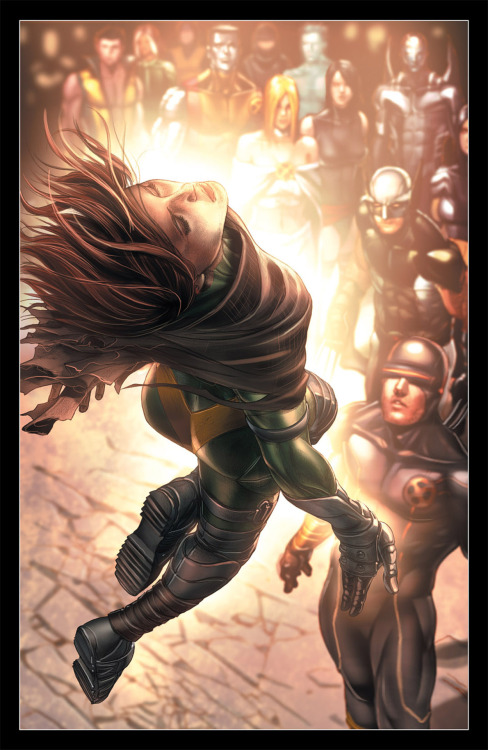
So, imagine for a moment that you're a nanoscout in an editorial bullpen at Marvel Comics. It's somewhere around the mid to late 1970's and you're dealing with a fellow that used to be a gofer but can call himself a writer now, really and truly. This sparkly fellow, who lives and breathes these mutants through and through, is Chris Claremont, the originator of The Phoenix Saga, at his absolute prime. It's the prime of Miss Jean Grey as The Phoenix, as well, coming out of the darkness. Immense forty-foot tall avatars of Len Wein and Bob Harras are breathing down everyone's neck over the death of the Broccoli People, whose tiny fictional solar system was snuffed out by that fiery telekinetic redhead in shockingly descriptive detail not too long ago. Claremont, glowing with all the vim and vinegar allotted to him in his contract (Stan Lee sits in an immense hot tub on the next level up in the building, charging outrageous parties to the petty cash box and using such contracts to light his expensive imported cigars) explains how the rehabilitation of Jean Grey will occur.
The sevenfold veil of Marvel editorial eidolons parts, and a booming voice issues forth, shaking everyone present to the rims of their bellbottoms, as a three-faced robed figure emerges in hard-light hologram.
SHE KILLED BILLIONS, the Living Tribunal states in precise monotone, SHE MUST BE PUT IN JAIL FOREVER OR KILLED. THE COMICS CODE AUTHORITY IS EXPLICIT IN THIS REGARD.
Claremont, crushed, rushes into his tiny office cave and hastily works out the final outfit Jean Grey will wear. It'll be the Shiar that pass judgment on her, yes, those pristine imperial scum. She deserves a second chance. He imbued her with powers after a creature that had resurrection built into its function, for crying out loud. As ever, Claremont knows, the important bit is to approach these characters as if they were well established actors providing an excellent play. He had to have the motivations down, or it would fall flat.
Suicide by laser on the Blue Area of the Moon. Cyclops, crushed, to be consoled soon by a clone who he would have a son with. That son would be thrust into a dark future where Apocalypse, genetic supremacist mutant, is destined to rule. That son would return older than his father, much later, after Jean Grey's return ("Hey guys? She was on the bottom of this river! In an energy cocoon! Nyah.") to raise the first mutant born since M Day, when almost all the mutants lost their powers. That mutant's name would be Hope and the Phoenix would come for her.
But not without the process being drawn out among multiple titles for nearly a year.

It should be said, the maximized cross-over super-event Avengers vs. X-Men has gone directions that not all that many readers predicted (unless, of course, they proceed in that joyless endeavor of "reading ahead" in the various teasers and previews) but in more recent issues has come to the dilemma of all such major universe-rattling plots, the diffusion of tension.

After the Phoenix is splintered by Iron Man's Phoenix Buster, five mutants are chosen to live in a Utopia and have their authority questioned by the entrenched power structures. Find out what happens when heroes stop being polite, and start posturing in angry ideologies that shape the world. The Real World: Marvel 616.
If you're just joining us, Emma Frost gently pushed Namor into attacking Wakanda to rescue Hope (and, um, drown thousands of innocent civilians in the process), and the Avengers did their best and take the fellow down. Succeeding, Namor's portion of the Phoenix Force was transferred to the remaining four. When, during a rescue mission, Spider-Man taunts Magik and Colossus into cancelling each other out ("I'll stop you... with the power of laughter!" or something to that effect), Cyclops and a newly rekindled (no pun intended) homicidal megalomaniac Emma Frost are the last... um, Phoenixes standing.
And that's the real shame of the matter. The Phoenix has always embodied a fusion of opposites. The message that comes across in this crossover is that the pathway to hell is always paved with good intentions. With good must come bad, and with life, death. To imagine that the powers would corrupt these noble heroes (who, admittedly, have been shifting more and more into a morally gray area) is to discount the efforts of Charles Xavier, for decades reiterating that peace and reason are the solution to the turmoil and murk that the 616 Universe often finds itself grappling with. And that's just the murk that results from convolutions of plot since Claremont started the Phoenix rollercoaster/death of Jean Grey/clone/future storylines that ground most plots into dust until more recent efforts gave the teams and characters new and more energized focus. Like a laser. Ahem.


So, after so many years of Danger Rooms and such, when imbued with the Phoenix Force, Cyclops is corrupted. So it goes. Emma Frost is to blame, perhaps. Or perhaps these years since Jean Grey's final death, at the hands of a faux Magneto that ripped New York apart, had changed Scott Summers too much, and his investment in Hope was too great. Or perhaps the Phoenix Force is too much for oldboy. It works. It works on multiple levels. And for that, we have the current authors involved to thank.

Each issue of Avengers vs. X-Men is plotted by the same five writers that have taken turns scripting, issue by issue. Jason Aaron's turn at scripting provided ample comfort with the mutants, and clean dialogue. Brian Michael Bendis took a more action-based "cinematic" set-piece for the scripts he ran on, which is his strength. Ed Brubaker writes a mixed bag of events, zeroing in on key moments of characterization and domino toppling. Matt Fraction's comfort with the Avenger's end of the spectrum, especially Thor and Tony Stark, gives girth to his portion of the story. Jonathan Hickman, of course gives an intelligent weight to his scripts, packing in information that drives the story with a scale and complexity not unlike a decent Dune novel.
It's a unique opportunity provided by each writer to play to their own strengths, no doubt assessed and analyzed by editors (Jake, Lauren, Nick, Tom and Axel) prior to the plot points being anchored and assigned. Of course, the rotating artists, the second generation powerhouses such as the Adam Kubert and John Romita Jr, even Oliver Copiel in conjunction with Mark Morales, transition less jarringly than one might expect, as the story unfolds, and it seems that in this project a good time was had by all. Laura Martin and Larry Molinar do a fine service to color duties. Overall, everyone did their job well and should expect a dump truck filled with money to be backed up to their brand new empty heart-shaped pools, hollowed out by fanboys that vainly wanted to believe, if only for a moment, that the X-Men, the eternal underdogs and demagogues, stood a chance against the mega-noble hardcases that raked in more billions than some counties (or countries) will ever even see. If only this sort of care and attention was invested in so many titles as AvX houses (only a few dozen, modest by superhero crossover terms), then surely a new golden age, blessed by the ghost of Jack Kirby himself, would ring out over the dusty bins of bagged and sealed promotional materials and movies waiting to happen, in comic book shops throughout the country.
But.
This is all a build-up to the next big thing.

There is always a follow-up to major cross-over events, no matter how the drab tangential storylines play out. Nevermind the plotholes and inconsistencies and linear gaps and Xavier mind-wiping everyone at one point, nevermind the characters in jail or out, or who got beaten up by whom or what dialogue did or did not happen when Gambit fought Captain America, briefly, for the rod of relevance. There is more time travel yet to come. And more shifts in writing duties. Comfort zones shifting. Golden ages packing their bags and awaiting the Silver Aeon, overseen by Rocket Raccoon and Groot for some reason, maybe a movie, maybe the recently shark-jumped and all pervasive trend of remaking and remaking and remaking until the whole mess is meta-regurgitation/vomit/feces.
Prepare yourselves for Marvel, now (sorry, I mean Marvel NOW!). It's recommended, if you are a diehard fan, that you insinuate yourself into a comfortable seat, and remember that it's been done before. If you're invested in the stories, good, that means that the writers are doing their job. If you're angry about creative team swaps, or ambivalent, don't flinch, not yet. Be prepared to. This is the answer to New 52. If not, now, never. Avengers vs. X-Men merely paved the way. The appearance of a game-plan being in place is reassuring, even in the unlikely event of a catastrophic cosmic prolapse.
The story has not yet fully resolved itself. The proverbial "suicide shot on the Blue Area of the Moon" has not come. Yet. The Living Tribunal has not yet spoken the last words of the day. The Watcher's patented "disapproving look" has not reached peak sadness. Yet.
It's coming. The next "Impressions of Avengers vs. X-Men" will be the last.
Sponsored by Rocket Raccoon.
Rocket Raccoon being the cornerstone of the Marvel Multiverse, after all.
The sevenfold veil of Marvel editorial eidolons parts, and a booming voice issues forth, shaking everyone present to the rims of their bellbottoms, as a three-faced robed figure emerges in hard-light hologram.
SHE KILLED BILLIONS, the Living Tribunal states in precise monotone, SHE MUST BE PUT IN JAIL FOREVER OR KILLED. THE COMICS CODE AUTHORITY IS EXPLICIT IN THIS REGARD.
Claremont, crushed, rushes into his tiny office cave and hastily works out the final outfit Jean Grey will wear. It'll be the Shiar that pass judgment on her, yes, those pristine imperial scum. She deserves a second chance. He imbued her with powers after a creature that had resurrection built into its function, for crying out loud. As ever, Claremont knows, the important bit is to approach these characters as if they were well established actors providing an excellent play. He had to have the motivations down, or it would fall flat.
Suicide by laser on the Blue Area of the Moon. Cyclops, crushed, to be consoled soon by a clone who he would have a son with. That son would be thrust into a dark future where Apocalypse, genetic supremacist mutant, is destined to rule. That son would return older than his father, much later, after Jean Grey's return ("Hey guys? She was on the bottom of this river! In an energy cocoon! Nyah.") to raise the first mutant born since M Day, when almost all the mutants lost their powers. That mutant's name would be Hope and the Phoenix would come for her.
But not without the process being drawn out among multiple titles for nearly a year.

These guys see Xavier rollin'. They hatin'.

Captain Britain, eternally upstaged by his betters
After the Phoenix is splintered by Iron Man's Phoenix Buster, five mutants are chosen to live in a Utopia and have their authority questioned by the entrenched power structures. Find out what happens when heroes stop being polite, and start posturing in angry ideologies that shape the world. The Real World: Marvel 616.
If you're just joining us, Emma Frost gently pushed Namor into attacking Wakanda to rescue Hope (and, um, drown thousands of innocent civilians in the process), and the Avengers did their best and take the fellow down. Succeeding, Namor's portion of the Phoenix Force was transferred to the remaining four. When, during a rescue mission, Spider-Man taunts Magik and Colossus into cancelling each other out ("I'll stop you... with the power of laughter!" or something to that effect), Cyclops and a newly rekindled (no pun intended) homicidal megalomaniac Emma Frost are the last... um, Phoenixes standing.
And that's the real shame of the matter. The Phoenix has always embodied a fusion of opposites. The message that comes across in this crossover is that the pathway to hell is always paved with good intentions. With good must come bad, and with life, death. To imagine that the powers would corrupt these noble heroes (who, admittedly, have been shifting more and more into a morally gray area) is to discount the efforts of Charles Xavier, for decades reiterating that peace and reason are the solution to the turmoil and murk that the 616 Universe often finds itself grappling with. And that's just the murk that results from convolutions of plot since Claremont started the Phoenix rollercoaster/death of Jean Grey/clone/future storylines that ground most plots into dust until more recent efforts gave the teams and characters new and more energized focus. Like a laser. Ahem.

The idea of Cyclops being a myopic self-centered god-like being is about as fun as it sounds.
Where does Xavier really stand in all this? He's been shuffled into the background of each and every X-Men title (notable exception being his visit to Wolverine's new school) for quite some time. Prior to the maddeningly and surprisingly dull Skrull Invasion, he had a place at the seat of the Marvel Illuminati, but perhaps, without crippling him again, or outright killing him (remember Bishop? How he shot Professor X once? How he's nowhere to be seen for any of this?), the creative teams have seen fit to stomp his dream of peaceful coexistence, the Utopia that the Phoenix Five would have had, if they'd been able to maintain control (insert What If? issue HERE), into so much dust.
There's a moment, and maybe you'll catch it. Here...

The only other time I've seen Cap cry is that time Red Skull gouged his eyes out on the steps of Capitol Hill.
Remember, Cyclops was Xavier's star pupil from teen years, and Wolverine the dangerous Giant-Size-come-lately rogue (much older than Captain America, even). For all the posturing done, it's been nearly but not completely subtle, the shift that those two characters have undergone in recent years, Cyclops the militant edge in league with Magneto, thrice-time reformed supervillain (himself plagued with legions of hackneyed clones), and Wolverine, the immortal-by-way-of-popularity, the killer with a soft streak, rebuilding the school and adding a Baby Krakoa.
So, after so many years of Danger Rooms and such, when imbued with the Phoenix Force, Cyclops is corrupted. So it goes. Emma Frost is to blame, perhaps. Or perhaps these years since Jean Grey's final death, at the hands of a faux Magneto that ripped New York apart, had changed Scott Summers too much, and his investment in Hope was too great. Or perhaps the Phoenix Force is too much for oldboy. It works. It works on multiple levels. And for that, we have the current authors involved to thank.

What nobody mentions is, Hope's been listening to Wu Tang Clan during her training sessions.
Each issue of Avengers vs. X-Men is plotted by the same five writers that have taken turns scripting, issue by issue. Jason Aaron's turn at scripting provided ample comfort with the mutants, and clean dialogue. Brian Michael Bendis took a more action-based "cinematic" set-piece for the scripts he ran on, which is his strength. Ed Brubaker writes a mixed bag of events, zeroing in on key moments of characterization and domino toppling. Matt Fraction's comfort with the Avenger's end of the spectrum, especially Thor and Tony Stark, gives girth to his portion of the story. Jonathan Hickman, of course gives an intelligent weight to his scripts, packing in information that drives the story with a scale and complexity not unlike a decent Dune novel.
It's a unique opportunity provided by each writer to play to their own strengths, no doubt assessed and analyzed by editors (Jake, Lauren, Nick, Tom and Axel) prior to the plot points being anchored and assigned. Of course, the rotating artists, the second generation powerhouses such as the Adam Kubert and John Romita Jr, even Oliver Copiel in conjunction with Mark Morales, transition less jarringly than one might expect, as the story unfolds, and it seems that in this project a good time was had by all. Laura Martin and Larry Molinar do a fine service to color duties. Overall, everyone did their job well and should expect a dump truck filled with money to be backed up to their brand new empty heart-shaped pools, hollowed out by fanboys that vainly wanted to believe, if only for a moment, that the X-Men, the eternal underdogs and demagogues, stood a chance against the mega-noble hardcases that raked in more billions than some counties (or countries) will ever even see. If only this sort of care and attention was invested in so many titles as AvX houses (only a few dozen, modest by superhero crossover terms), then surely a new golden age, blessed by the ghost of Jack Kirby himself, would ring out over the dusty bins of bagged and sealed promotional materials and movies waiting to happen, in comic book shops throughout the country.
This is all a build-up to the next big thing.

Dammit, why did Nick Fury's son have to look exactly like Ultimate Nick Fury, again? Really, people. C'mon.
There is always a follow-up to major cross-over events, no matter how the drab tangential storylines play out. Nevermind the plotholes and inconsistencies and linear gaps and Xavier mind-wiping everyone at one point, nevermind the characters in jail or out, or who got beaten up by whom or what dialogue did or did not happen when Gambit fought Captain America, briefly, for the rod of relevance. There is more time travel yet to come. And more shifts in writing duties. Comfort zones shifting. Golden ages packing their bags and awaiting the Silver Aeon, overseen by Rocket Raccoon and Groot for some reason, maybe a movie, maybe the recently shark-jumped and all pervasive trend of remaking and remaking and remaking until the whole mess is meta-regurgitation/vomit/feces.
Prepare yourselves for Marvel, now (sorry, I mean Marvel NOW!). It's recommended, if you are a diehard fan, that you insinuate yourself into a comfortable seat, and remember that it's been done before. If you're invested in the stories, good, that means that the writers are doing their job. If you're angry about creative team swaps, or ambivalent, don't flinch, not yet. Be prepared to. This is the answer to New 52. If not, now, never. Avengers vs. X-Men merely paved the way. The appearance of a game-plan being in place is reassuring, even in the unlikely event of a catastrophic cosmic prolapse.
The story has not yet fully resolved itself. The proverbial "suicide shot on the Blue Area of the Moon" has not come. Yet. The Living Tribunal has not yet spoken the last words of the day. The Watcher's patented "disapproving look" has not reached peak sadness. Yet.
It's coming. The next "Impressions of Avengers vs. X-Men" will be the last.
Sponsored by Rocket Raccoon.
Rocket Raccoon being the cornerstone of the Marvel Multiverse, after all.